1
Physics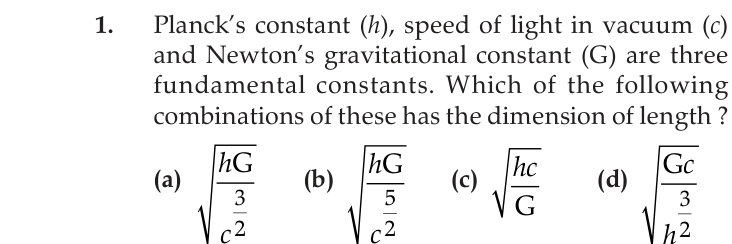
Planck’s constant (h), speed of light in vacuum (c) and Newton’s gravitational constant (G) are three fundamental constants. Which of the following combinations of these has the dimension of length ?
- A.(A)
- B.(B)
- C.(C)
- D.(D)
Attempt the official NEET previous year question paper 2016 Phase II as a free, timed mock test on AajExam. Get instant scoring, sectional analysis, and detailed solutions for every question.
| Section | Questions | Marks/Q | Negative |
|---|---|---|---|
| Physics | 45 | 4 | 1 |
| Chemistry | 45 | 4 | 1 |
| Biology | 90 | 4 | 1 |
Showing 5 of 180 questions. Start the mock test to attempt all questions in timed mode.
Planck’s constant (h), speed of light in vacuum (c) and Newton’s gravitational constant (G) are three fundamental constants. Which of the following combinations of these has the dimension of length ?
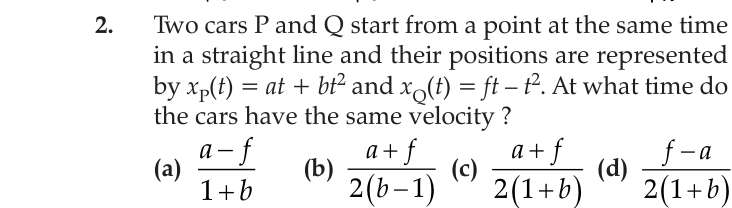
Two cars P and Q start from a point at the same time in a straight line and their positions are represented by x_(P)(t) = at + bt² and x_(Q)(t) = ft – t². At what time do the cars have the same velocity ?
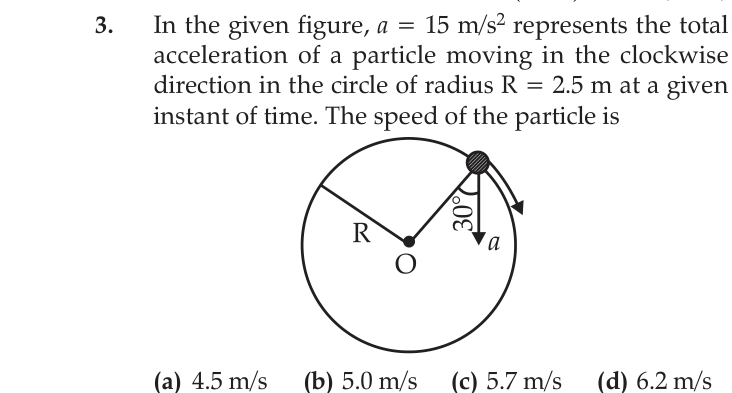
In the given figure, a = 15 m/s² represents the total acceleration of a particle moving in the clockwise direction in the circle of radius R = 2.5 m at a given instant of time. The speed of the particle is
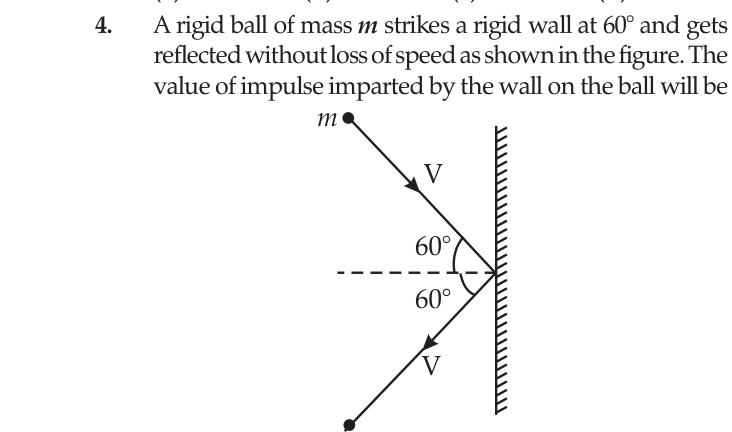
A rigid ball of mass m strikes a rigid wall at 60° and gets reflected without loss of speed as shown in the figure. The value of impulse imparted by the wall on the ball will be m V 60° V 60°
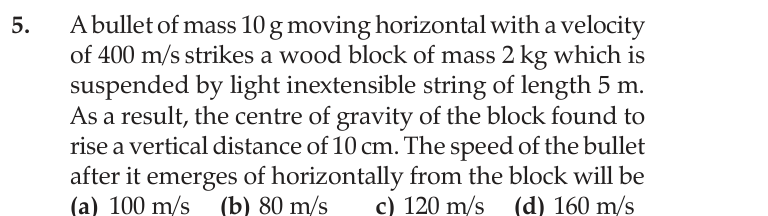
A bullet of mass 10 g moving horizontal with a velocity of 400 m/s strikes a wood block of mass 2 kg which is suspended by light inextensible string of length 5 m. As a result, the centre of gravity of the block found to rise a vertical distance of 10 cm. The speed of the bullet after it emerges of horizontally from the block will be
You've seen 5 sample questions. Create a free account in 30 seconds to attempt the full paper with timer, scoring, and detailed solutions.
NEET (UG) 2016 (Phase II) is part of our PRO plan. The latest year's NEET paper is always free; older papers are available with an AajExam PRO subscription that unlocks the full NEET PYQ archive.
The paper contains 180 multiple-choice questions to be attempted in 180 minutes for a total of 720 marks, with 1 negative marking per wrong answer.
The NEET 2016 paper covers the following sections: Physics, Chemistry, Biology. Each section is designed to test a specific skill set required for the NEET exam.
Yes. Every question on this PYQ paper has the correct answer and a detailed explanation. After submitting the test, you can review each question with step-by-step solutions, concept references, and tips on how to solve similar questions faster.
Yes. You can attempt this PYQ paper as many times as you like. Each attempt is recorded separately so you can track improvement in score, accuracy, and time-management.
Government exam toppers consistently say PYQ practice is the single highest-leverage strategy. NEET repeats question patterns, frequently-tested concepts and difficulty distribution year after year. Solving 8-10 PYQ shifts before the exam dramatically improves time management and confidence.