UPSC Prelims CSAT (Aptitude) — Previous Year Questions
870 CSAT (Aptitude) questions asked in past UPSC Prelims papers, split into 87 timed practice sets — every question with its answer and explanation.
About UPSC Prelims CSAT (Aptitude) previous year questions
CSAT (Aptitude) PYQs asked in UPSC Prelims
A sample of 30 questions from the full bank of 870. Try each one before opening the solution — the remaining questions are in the timed practice sets below.
Q1.Direction for the following 7 (seven) items: Read the following five passages and answer the items (61-67) that follow each passage. Your answers to these items should be based on the passages only. Passage–1 India’s economic footprint, given its population, still remains small compared to the US, the European Union or China. It has much to learn from other economies, yet must implement solutions that fit its unique circumstances. India especially needs an effective long-term regulatory system based on collaboration rather than the current top-down approach. Regulations seek desirable outcomes yet are repeatedly used as political tools to push one agenda or another. Often, regulations fail to consider impacts on jobs and economic growth — or less restrictive alternatives. Regulations may be used to protect local markets at the expense of more widely shared prosperity in the future. Additionally, regulations inevitably result in numerous unintended consequences. In today’s hyper competitive global economy, regulations need to be viewed as “weapons” that seek cost- justified social and environmental benefits while improving the economic well-being of most citizens. Which one of the following is the most logical, rational and crucial inference that can be derived from the above passage?
- A.A better regulatory system will help India achieve the size of economy appropriate to its population.
- B.In a competitive global economy, India must use regulations strategically.
- C.Regulations in India do not favour its integration with today’s hyper, competitive global economy.
- D.Job creation and economic growth should be dominant considerations in developing India’s regulatory system.
Show answer
Answer: A. A better regulatory system will help India achieve the size of economy appropriate to its population.
The author in the passage asserts that a regulation system is in place in India. But there are some short comings in it. Politicians use it for their vested interests. It does not address the factors like job creation and economic growth. Regulations are required in a competitive global economy. However, the regulation system shall focus on bringing social and economic benefits to the general publ
Q2.On the basis of the above passage, the following assumptions have been made: In today’s global economy, 1. regulations are not effectively used to protect local markets. 2. social and environmental concerns are generally ignored by the governments across the world while implementing the regulations. Which of the above assumptions is/are valid?
- A.1 only
- B.2 only
- C.Both 1 and 2
- D.Neither 1 nor 2
Show answer
Answer: D. Neither 1 nor 2
The passage gives the message that, In a competitive global economy, India must use regulations strategically. It needs a collaborative system of regulations aimed at prosperity instead of protecting local markets at its expense. Hence, option (d) is correct. Here both statement (1) and (2) are incorrect.
Q3.Passage–2 In a study, scientists compared the microbiomes of poorly nourished and well-nourished infants and young children. Gut microbes were isolated from faecal samples of malnourished and healthy children. The microbiome was “immature” and less diverse in malnourished children compared to the better developed “mature” microbiome found in healthy children of the same age. According to some studies, the chemical composition of mother’s milk has shown the presence of a modified sugar (sialylated oligosaccharides). This is not utilized by the baby for its own nutrition. However, the bacteria constituting the infant’s microbiome thrive on this sugar which serves as their food. Malnourished mothers have low levels of this sugar in their milk. Consequently, the microbiomes of their infants fail to mature. That in turn, leads to malnourished babies. Which one of the following is the most logical, rational and crucial inference that can be derived from the above passage?
- A.If malnourished condition in children is caused by gut bacteria, it cannot be treated.
- B.The guts of malnourished babies should be inoculated with mature microbiomes.
- C.Babies of malnourished mothers should be fed with dairy milk fortified with sialylated oligosaccharides instead of mother’s milk.
- D.Research on benign effects of gut bacteria on nutrition has policy implications.
Show answer
Answer: D. Research on benign effects of gut bacteria on nutrition has policy implications.
The passage compares a healthy child with a malnourished child. It refers to a study done by scientists to find the reason for the malnutrition of some children. The study was based on analysing the microbiomes of both types of children. It was found that the milk from a malnourished mother lacks a special type of sugar ‘sialylated oligosaccharides’. However, research on the benign effects of gut
Q4.On the basis of the above passage, the following assumptions have been made: 1. Processed probiotic foods are a solution to treat the children suffering from malnu- trition due to immature gut bacteria composition. 2. The babies of malnourished mothers generally tend to be malnourished. Which of the above assumptions is/are valid?
- A.1 only
- B.2 only
- C.Both 1 and 2
- D.Neither 1 nor 2
Show answer
Answer: B. 2 only
The malnourishment in the babies is directly linked with the malnourishment in the mothers. The milk of malnourished mothers fails to provide healthy sugar to their children. Hence, microbiomes cannot develop in these children and they become malnourished. Statement 2 is correct. Probiotics are live yeasts and good bacteria that live in the body and are good for the digestive system. One can take
Q5.Passage–3 Temperatures have risen nearly five times as rapidly on the Western Antarctic Peninsula than the global average over the past five decades. Researchers have now found that melting glaciers are causing a loss of species diversity among benthos in the coastal waters off the Antarctic Peninsula, impacting an entire seafloor ecosystem. They believe increased levels of suspended sediment in water to be the cause of the dwindling biodiversity in the coastal region. On the basis of the above passage, the following assumptions have been made: 1. Regions of glaciers warm faster than other regions due to global warming. 2. Global warming can lead to seafloor sedimentation in some areas. 3. Melting glaciers can reduce marine biodiversity in some areas. Which of the above assumptions is/are valid?
- A.1 and 2 only
- B.3 only
- C.2 and 3 only
- D.1, 2 and 3
Show answer
Answer: C. 2 and 3 only
Statement 1 is supported by the first sentence of the passage which clearly states that the difference in the rate of warming in the Antarctic region is five times more than the other regions. But, rate of warmness of regions of glaciers are not faster than many other regions . Hence, statement 1 is incorrect. In the middle part of the passage, sedimentation of the sea bed has been presented as a
Q6.Passage–4 A research team examined a long-term owl roost. Owls prey on small mammals and the excreted remains of those meals that accumulated over the time, provide us an insight into the composition and structure of small mammals over the past millennia. The research suggested that when file Earth went through a period of, rapid warming about 13,000 years ago, the small mammal community was stable and resilient. But, from the last quarter of the nineteenth century, human-made changes to the environment had caused an enormous drop in biomass and energy flow. This dramatic decline in energy flow means modern ecosystems are not adapting as easily as they did in the past: On the basis of the above passage, the following assumptions have been made: 1. Global warming is a frequently occurring natural phenomenon. 2. The impending global warming will not adversely affect small mammals. 3. Humans are responsible for the loss of the Earth’s natural resilience. Which of the above assumptions is/are valid?
- A.1 and 2 only
- B.3 only
- C.2 and 3 only
- D.1, 2 and 3
Show answer
Answer: B. 3 only
It is not that global warming has been a frequent phenomenon on earth. The passage is talking about something that had happened 13000 years ago. On basis of this, we cannot assume that global warming is a recurring event. The passage contradicts the information given in statement 2. It says that human-induced environmental changes will make adaption difficult for the same mammals that did easily d
Q7.Passage–5 Food varieties extinction is happening all over the world — and it is happening fast. For example, of the 7,000 apple varieties that were grown during the nineteenth century, fewer than a hundred remain. In the Philippines, thousands of varieties of rice once thrived; now only up to a hundred are grown there. In China, 90 percent of the wheat varieties cultivated just a century ago have disappeared. Farmers in the past painstakingly bred and developed crops well suited to the peculiarities of their local climate and environment. In the recent past, our heavy dependence on a few high yielding varieties and technology-driven production and distribution of food is causing the dwindling of diversity in food crops. If some mutating crop disease or future climate change decimates the few crop plants we have come to depend on to feed our growing population, we might desperately need some of those varieties we have let go extinct. On the basis of the above passage, the following assumptions have been made: 1. Humans have been the main reason for the large scale extinction of plant species. 2. Consumption of food mainly from locally cultivated crops ensures crop diversity. 3. The present style of production, and distribution of food will finally lead to the problem of food scarcity in the near future. 4. Our food security may depend on our ability to preserve the locally cultivated varieties of crops. Which of the above assumptions are valid?
- A.1 and 3
- B.2 and 4
- C.2 and 3
- D.1 and 4
Show answer
Answer: D. 1 and 4
The author is concerned about shrinking food variety. Human beings have become dependent on a limited number of food varieties. While a large number of varieties of crops were available in past, the technology has made us concentrate on only high yielding varieties. Over-dependence on these limited number of varieties is dangerous as some disease or human-induced climate change can render these va
Q8.If every alternative letter of the English alphabet from B onwards (including B) is written in lower case (small letters) and the remaining letters are capitalized, then how is the first month of the second half of the year written?
- A.JuLY
- B.jULy
- C.jUly
- D.jUlY
Show answer
Answer: D. jUlY
According to given condition, starting from A, odd place alphabet is in upper case and even place alphabet is in lower case. i.e. AbCd .... 1 2 3 4 J U L Y will be written as jUlY. 10 21 12 25
Q9.Sunita cuts a sheet of paper into three pieces. Length of first piece is equal to the average of the three single digit odd prime numbers. Length of the second piece is equal to that of the first plus one-third the length of the third. The third piece is as long as the other two pieces together. The length of the original sheet of paper is
- A.13 units
- B.15 units
- C.16 units
- D.30 units
Show answer
Answer: D. 30 units
Prime numbers of single digits are 3, 5, 7 their average = 3 5 7 3 5 Length of first piece = 5 units Let length of second piece = x units \ Length of third piece = 5 + x units According to given condition, x = 5 + 5 3 + x ⇒ x = 15 5 3 + + x ⇒ 3x = 20 + x ⇒ 2x = 20 ⇒ x = 10 units Length of original paper = 5 + 10 + (10 + 5) = 30 units.
Q10.In the sequence 1, 5, 7, 3, 5, 7, 4, 3, 5, 7, how many such 5s are there which are not immediately preceded by 3 but are immediately followed by 7?
- A.1
- B.2
- C.3
- D.None
Show answer
Answer: A. 1
1, 5 , 7, 3, 5, 7, 4, 3, 5, 7 In the sequence, there is only one 5 that is not preceded immediately by 3.
Q11.Passage–2 The man who is perpetually hesitating about which of the two things he will do first will do neither. The man who resolves, but suffers his resolution to be changed after the first counter-suggestion of a friend—who fluctuates from opinion to opinion and veers from plan to plan—can never accomplish anything. He will at best be stationary and probably retrograde in all. It is only the man—who first consults wisely, then resolves firmly and then executes his purpose with inflexible perseverance, undismayed by those petty difficulties which daunt a weaker spirit—that can advance to eminence in any line. The keynote that seems to be emerging from the passage is that
- A.we should first consult wisely and then resolve firmly.
- B.we should reject suggestions of friends and remain unchanged.
- C.we should always remain broad-minded.
- D.we should be resolute and achievement- oriented. UPSC CIVIL SERVICES EXAMINATION (PRELIMS)-CSAT
Show answer
Answer: A. we should first consult wisely and then resolve firmly.
The author is very clear in his objective and message. Success is everyone’s dream. But it is a common habit to lose focus and interest if someone close discourages us. This tendency is strongly opposed by the author in the passage; he says that a man should always be resolute and achievement-oriented ignoring all the opinions after taking the first step. Consult only before setting a goal and con
Q12.Passage–3 During the summer in the Arctic Ocean, sea ice has been melting earlier and faster, and the winter freeze has been coming later. In the last three decades, the extent of summer ice has declined by about 30 per cent. The lengthening period of summer melt threatens to undermine the whole Arctic food web, atop which stand polar bears. Which among the following is the most crucial message conveyed by the above passage?
- A.Climate change has caused Arctic summer to be short but temperature to be high.
- B.Polar bears can be shifted to the South Pole to ensure their survival.
- C.Without the presence of polar bears, the food chains in the Arctic region will disappear.
- D.Climate change poses a threat to the survival of polar bears.
Show answer
Answer: D. Climate change poses a threat to the survival of polar bears.
Option (b) is illogical and thus, can be concluded as the incorrect option. Option (a) is false as the Arctic summers have now become long and the temperature too remains unprecedently high. But this is not the crucial message of the passage. Option (c) cannot be deduced from the passage. The disturbance in the food chain can be understood but the disappearance of the complete food chain is beyond
Q13.Passage–4 Why do people prefer open defecation and not want toilets or, if they have them, only use them sometimes? Recent research has shown two critical elements: ideas of purity and pollution, and not wanting pits or septic tanks to fill because they have to be emptied. These are the issues that nobody wants to talk about, but if we want to eradicate the practice of open defecation, they have to be confronted and dealt with properly. Which among the following is the most crucial message conveyed by the above passage?
- A.The ideas of purity and pollution are so deep-rooted that they cannot be removed from the minds of the people.
- B.People have to perceive toilet use and pit- emptying as clean and not polluting.
- C.People cannot change their old habits.
- D.People have neither civic sense nor a sense of privacy.
Show answer
Answer: B. People have to perceive toilet use and pit- emptying as clean and not polluting.
People prefer open defecation to have under- ground septic tanks in homes. They have a wrong idea of cleaning; they think that pit cleaning is a polluting dirty thing. The author states in the passage that this perception of people has to be confronted and dealt with properly. The idea of purity of people is misplaced. It can be corrected under proper guidance as per the author. The author is hope
Q14.Passage–5 In the last two decades, the world’s Gross Domestic Product (GDP) has increased by 50 per cent, whereas inclusive wealth has increased by a mere 6 per cent. In recent decades, GDP-driven economic performance has only harmed inclusive wealth like human capital; and natural capital like forests, land and water. While the world’s human capital which stands at 57 per cent of total inclusive wealth grew by only 8 per cent, the natural capital which is 23 per cent of total inclusive wealth declined by 30 per cent worldwide in the last two decades. Which of the following is the most crucial inference from the above passage?
- A.More emphasis should be laid on the development of natural capital.
- B.The growth driven only by GDP is neither desirable nor sustainable.
- C.The economic performance of the countries of the world is not satisfactory.
- D.The world needs more human capital under the present circumstances.
Show answer
Answer: B. The growth driven only by GDP is neither desirable nor sustainable.
The passage support the statement that the GDP driven growth in only one way which does not encourage the growth of natural capital. It is correct to say that GDP driven growth is undesirable or unsustainable. This is supported by the passage. Option (b) is correct. Option (c) is a vague statement. If we measure the growth in terms of GDP then, 50% growth in two decades is a very encouraging figur
Q15.Passage–6 By 2025, when the global economy is expected to run short of 56 million young people, India, with its youth surplus of 47 million, could fill the gap. It is in this context that labour reforms are often cited, as the way to unlock double-digit growth in India. In 2014, India’s labour force was estimated to be about 40 per cent of the population, but 93 per cent of this force was in the unorganized sector. Over the last decade, the Compound Annual Growth Rate (CAGR) of employment has slowed to 0.5 per cent, with about 14 million jobs created during last year when the labour force increased by about 15 million. Which of the following is the most rational inference from the above passage?
- A.India must control its population growth so as to reduce its unemployment rate.
- B.Labour reforms are required in India to make optimum use of its vast labour force productively.
- C.India is poised to achieve double-digit growth very soon.
- D.India is capable of supplying skilled young people to other countries.
Show answer
Answer: B. Labour reforms are required in India to make optimum use of its vast labour force productively.
The global economy is expected to run short of 56 million young people, and India, with its youth surplus of 47 million, could fill the gap. This is the opening part of the passage. Therefore, option (d) is correct. Option (a) is incorrect. Population control is not discussed as a measure to address the problem. It has been mentioned in the passage that labour reforms are needed to unlock double-d
Q16.Passage–7 The very first lesson that should be taught to us when we are old enough to understand it, is that complete freedom from the obligation to work is unnatural, and ought to be illegal, as we can escape our share of the burden of work only by throwing it on someone else’s shoulders. Nature ordains that the human race shall perish of famine if it stops working. We cannot escape from this tyranny. The question we have to settle is how much leisure we can afford to allow ourselves. The main idea of the passage is that
- A.it is essential for human beings to work.
- B.there should be a balance between work and leisure.
- C.working is a tyranny which we have to face.
- D.human’s understanding of the nature of work is essential.
Show answer
Answer: A. it is essential for human beings to work.
Work is essential for the human race. It is unnatural and illegal to escape from work and throw the responsibility on others. Any type of engagement is essential for human beings. Complete absence of labour will eventually lead to the complete destruction of the human race. The most crucial inference expressed in passage is reflect in option (a), which is the correct answer. Leisure is also import
Q17.Passage–8 There is no harm in cultivating habits so long as they are not injurious. Indeed, most of us are little more than bundle of habits. Take away our habits and the residuum would hardly be worth bothering about. We could not get on without them. They simplify the mechanism of life. They enable us to do a multitude of things automatically, which, if we had to give fresh and original thought to them each time, would make existence an impossible confusion. The author suggests that habits
- A.tend to make our lives difficult
- B.add precision to our lives
- C.make it easier for us to live
- D.tend to mechanize our lives
Show answer
Answer: C. make it easier for us to live
Option (c) is correct because according to the author, habits simplify the mechanism of life. Habits are so important to human personality that without them human life cannot be imagined. We are servants of our habits; they automate our actions. Without habits, our life will remain in confusion. We can conclude on the basis of our reading of the passage that habits make human life easier. Option (
Q18.Direction for the following 2 (two) items: Consider the given information and answer the two items (9-10) that follow. No supporters of “Party X’, who knew Z and supported his campaign strategy, agreed to the alliance with “Party Y’, but some of them had friends in ‘Party Y’. With reference to the above information, which one among the following statements must be true?
- A.Some supporters of “Party Y’ did not agree to the alliance with ‘Party X’.
- B.There is at least one supporter of ‘Party Y’ who knew some supporters, of ‘Party X’ as a friend.
- C.No supporters of ‘Party X’ supported Z’s campaign strategy.
- D.No supporters of ‘Party X’ knew Z.
Show answer
Answer: B. There is at least one supporter of ‘Party Y’ who knew some supporters, of ‘Party X’ as a friend.
(a) Nowhere, it is given that supporters of ‘Party Y’ agreed for alliance with ‘Party X’. (b) It is given that some supporters of ‘Party X’ had friends in ‘Party Y’. So, atleast one supporter of ‘Party Y’ was there who knew some supporters of ‘Party X’. Option (c) and (d) are also wrong from the given information.
Q19.Direction for the following 2 (two) items: Consider the given information and answer the two items (9-10) that follow. No supporters of “Party X’, who knew Z and supported his campaign strategy, agreed to the alliance with “Party Y’, but some of them had friends in ‘Party Y’. With reference to the above information, consider the following statements: 1. Some supporters of ‘Party X’ knew Z. 2. Some supporters of ‘Party X’, who opposed Z’s campaign strategy, knew Z. 3. No supporters of ‘Party X’ supported Z’s campaign strategy. Which of the statements given above is/are not correct?
- A.1 only
- B.2 and 3 only
- C.3 only
- D.1, 2 and 3
Show answer
Answer: C. 3 only
It is given that some supporters of ‘Party X’ knew Z and supported has campaign. So, statement 3 is wrong and statement 1 and 2 are correct.
Q20.If second and fourth Saturdays and all the Sundays are taken as only holidays for an office, what would be the minimum number of possible working days of any month of any year ?
- A.23
- B.22
- C.21
- D.20
Show answer
Answer: B. 22
We take February as it has minimum days (28 days). There are 4 complete weeks in February. So, it will have 4 Sundays and 2 Saturdays. Total holidays will be 6. \ Minimum working days = 28 – 6 = 22.
Q21.Lakshmi, her brother, her daughter and her son are badminton players. A game of doubles is about to begin: (i) Lakshmi’s brother is directly across the net from her daughter. (ii) Her son is diagonally across the net from the worst player’s sibling. (iii) The beat player and the worst player are on the same side of the net. Who is the best player?
- A.Her brother
- B.Her daughter
- C.Her son
- D.Lakshmi
Show answer
Answer: A. Her brother
According to given information, we can draw arrangement as: (Best) (Worst) Brother Laxmi Daughter Son So, best player is Laxmi’s Brother.
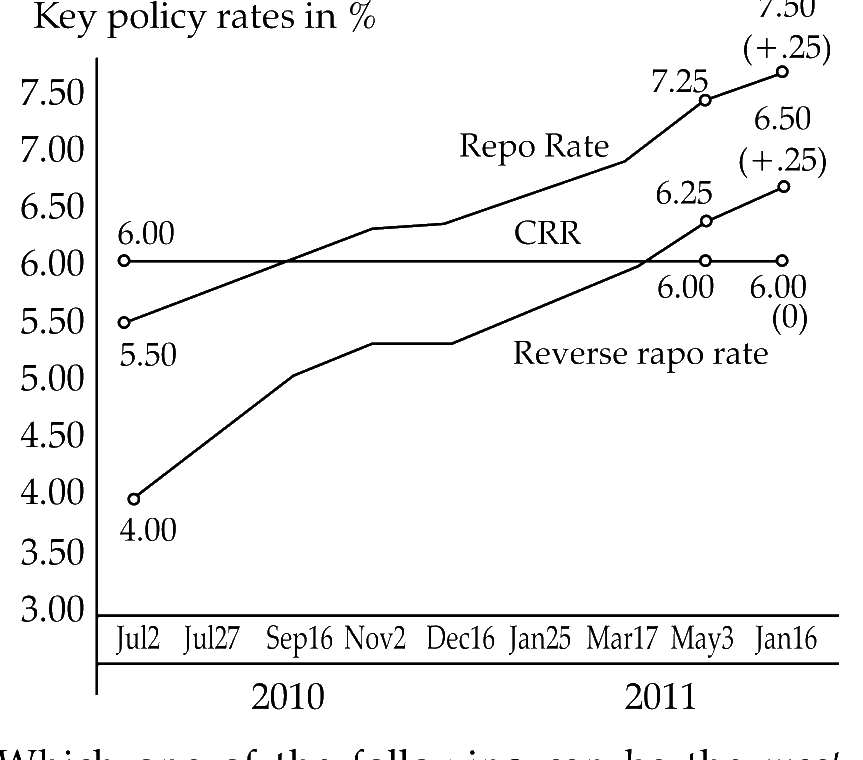
Q22.The graph given below indicates the changes in key policy rates made by the Central Bank several times in a year: Which one of the following can be the most likely reason for the Central Bank for such an action?
- A.Encouraging foreign investment
- B.Increasing the liquidity
- C.Encouraging both public and private savings
- D.Anti- inflationary stance
Show answer
Answer: D. Anti- inflationary stance
As per the graph, in last once year Reporate Increasing CRR Constant Reverse RR Increasing This kind of policy is taken to curb inflation.
Q23.Direction for the following 2 (two) items: The following table gives the GDP growth rate and Tele density data of different states of a country in a particular year. Study the table and answer the two items (74-75) that follow. States Per capita income ($) GDP growth rate (%) Tele den- sity State 1 State 2 State 3 State 4 State 5 State 6 State 7 State 8 State 9 State 10 State 11 State 12 State 13 State 14 State 15 State 16 State 17 State 18 9.52 5.31 10.83 9.78 10.8 11.69 8.88 5.92 7.76 9.55 4.7 7.85 9.37 5.46 7.48 7.03 5.8 7.49 70.27 35.88 50.07 5.94 76.12 77.5 104.86 6 82.25 96.7 57.7 63.8 52.3 97.9 62.3 93.8 49.9 47.84 With reference to the above table, which of the following is/are the most logical and rational inference/ inferences that can be made? 1. Higher per capita income is generally associated with higher tele density. 2. Higher GDP growth rate always ensures higher per capita income. 3. Higher GDP growth rate does not necessarily ensure higher tele density. Select the correct answer using the code given below.
- A.1 only
- B.2 and 3
- C.1 and 3
- D.3 only
Show answer
Answer: C. 1 and 3
As per the given data, 1. Most of higher per capita income states have higher tele-density. 2. As we see data of state-1 and state-3 then we can say higher GDP growth does not ensure higher per capita income always. 3. Compare data for state B and state II, we can see higher GDP has lower tele-density. So, only statement 1 and 3 are correct.
Q24.Direction for the following 2 (two) items: The following table gives the GDP growth rate and Tele density data of different states of a country in a particular year. Study the table and answer the two items (74-75) that follow. States Per capita income ($) GDP growth rate (%) Tele den- sity State 1 State 2 State 3 State 4 State 5 State 6 State 7 State 8 State 9 State 10 State 11 State 12 State 13 State 14 State 15 State 16 State 17 State 18 9.52 5.31 10.83 9.78 10.8 11.69 8.88 5.92 7.76 9.55 4.7 7.85 9.37 5.46 7.48 7.03 5.8 7.49 70.27 35.88 50.07 5.94 76.12 77.5 104.86 6 82.25 96.7 57.7 63.8 52.3 97.9 62.3 93.8 49.9 47.84 With reference to the above table, the following assumptions have been made: 1. Nowadays, prosperity of an already high performing State cannot be sustained without making further large investments in its telecom infrastructure. 2. Nowadays, a very high tele density is the most essential condition for promoting the business and economic growth in a state. Which of the above assumptions is/are valid ?
- A.1 only
- B.2 only
- C.Both 1 and 2
- D.Neither 1 nor 2
Show answer
Answer: D. Neither 1 nor 2
(i) Here, cannot is stressed much and as per data it is not correct. (ii) Here, most essential is given, which is not correct for every state (state 7 and 5) Both are wrong statements.
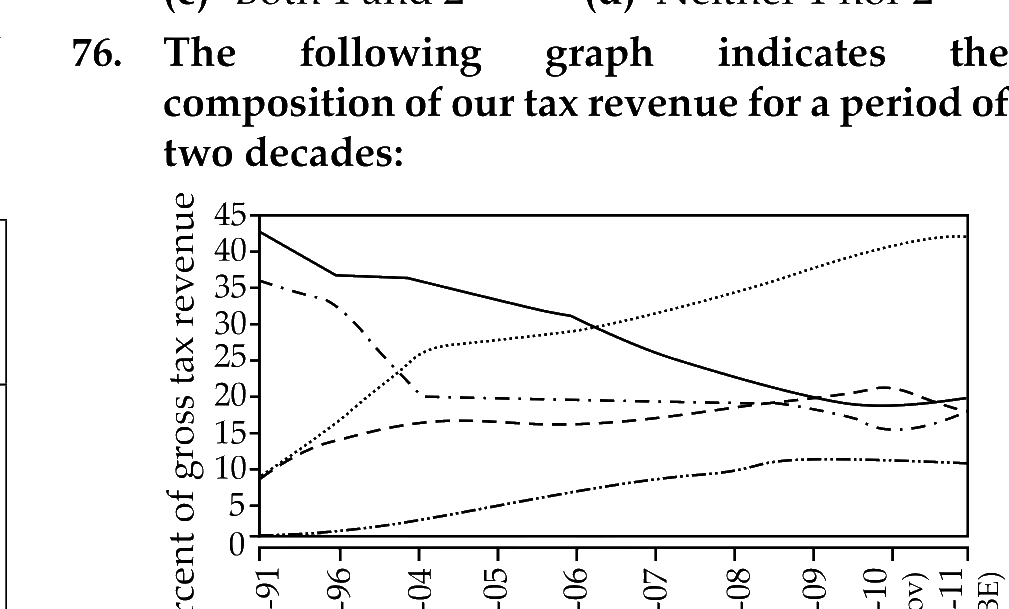
Q25.The following graph indicates the composition of our tax revenue for a period of two decades: With reference to the above graph, which of the following is/are the most logical and rational inference/ inferences that can be made? 1. During the given period, the revenue from Direct Taxes as percentage of gross tax revenue has increased while that of Indirect Taxes decreased. 2. The trend in the revenue from Excise Duty demonstrates that the growth of manufacturing sector has been negative during the given period. Select the correct answer using the code given below.
- A.1 only
- B.2 only
- C.Both 1 and 2
- D.Neither 1 nor 2
Show answer
Answer: A. 1 only
Direct taxes → Corporate and Income tax Indirect taxes → Excise, customs and service tax. 1. During the given period. Excise tax Decreasing Customs tax Decreasing Service tax Increasing (But less) Corporate tax Increasing highly Income tax Increasing So, statement 1 is correct. 2. We receive excise tax from non-manu- factured things like Tobacco. So, less excise tax does not mean decrease in manuf
Q26.If x – y = 8, then which of the following must be true ? 1. Both x and y must be positive for any value of x and y. 2. If x is positive, y must be negative for any value of x and y. 3. If x is negative, y must be positive for any value of x and y. Select the correct answer using the code given below.
- A.1 only
- B.2 only
- C.Both 1 and 2
- D.Neither 1 nor 2 nor 3
Show answer
Answer: D. Neither 1 nor 2 nor 3
Given that, X – Y = 8 (i) If x = 4 and y = – 4 x – y = 4 – (–4) = 8 (ii) If x = 10 and y = 2 x – y = 10 – 2 = 8 (iii) x = –2, y = –10 x – y = – 2 – (–10) = – 2 + 10 = 8 \ All statements are wrong.
Q27.Direction for the following 3 (three) items: Read the following two passage and answer the items (78-80) that follow. Your answers to these items should be based on the passages only. Passage - 1 The quest for cheap and plentiful meat has resulted in factory farms where more and more animals are squeezed into smaller lots in cruel and shocking conditions. Such practices have resulted in many of the world’s health pandemics such as the avian flu. Worldwide, livestock are increasingly raised in cruel, cramped conditions, where animals spend their short lives under artificial light, pumped full of antibiotics and growth hormones, until the day they are slaughtered. Meat production is water- intensive. 15000 litres of water is needed for every kilogram of meat compared with 3400 litres for rice, 3300 litres for eggs and 255 litres for a kilogram of potatoes. What is the most rational and crucial message given by the passage?
- A.Mass production of meat through industrial farming is cheap and is suitable for providing protein nutrition to poor countries.
- B.Meat-producing industry violates the laws against cruelty to animals.
- C.Mass production of meat through industrial farming is undesirable and should be stopped immediately.
- D.Environmental cost of meat production is unsustainable when it is produced through industrial farming.
Show answer
Answer: D. Environmental cost of meat production is unsustainable when it is produced through industrial farming.
Cheap mass production through industrial farming is shown in a negative sense in the passage. While option (a) gives the positive side of it. So, option (a) is not in coherence with the passage. It is an inference based on the abject conditions of livestock depicted in the passage. This is not the message of the author in the passage. Option (b) is incorrect. Mass production of meat is done to mee
Q28.Passage - 2 A male tiger was removed from Pench Tiger Reserve and was relocated in Panna National Park. Later, this tiger trekked toward his home 250 miles away. The trek of this solitary tiger highlights a crisis. Many wildlife reserves exist as islands of fragile habitat in a vast sea of humanity, yet tigers can range over a hundred miles, seeking prey, mates and territory. Nearly a third of India’s tigers live outside tiger reserves, a situation that is dangerous for both human and animal. Prey and tigers can only disperse if there are recognized corridors of land between protected areas to allow unmolested passage. Which of the following is the most rational and crucial message given by the passage?
- A.The conflict between man and wildlife cannot be resolved, no matter what efforts we make.
- B.Safe wildlife corridors between protected areas is an essential aspect of conservation efforts.
- C.India needs to declare more protected areas and set up more tiger reserves.
- D.India’s National Parks and Tiger Reserves need to be professionally managed.
Show answer
Answer: B. Safe wildlife corridors between protected areas is an essential aspect of conservation efforts.
Option (a) is out of the scope of the passage. It is incorrect to assume that Tiger reserves are managed unprofessionally in India. The passage is silent on this. Option (d) is incorrect. Eliminate (a) and (d). The author has mentioned that one-third of the tigers supposed to be living in tiger reserves live outside it and wander for different reasons in the thickly populated human areas. In this
Q29.With reference to the above passage, the following assumptions have been made: 1. The strategy of conservation of wildlife by relocating them from one protected area to another is not often successful. 2. India does not have suitable legislation to save the tigers, and its conservation efforts have failed which forced the tigers to live outside protected areas. Which of the above assumptions is/are valid?
- A.1 only
- B.2 only
- C.Both 1 and 2
- D.Neither 1 nor 2
Show answer
Answer: A. 1 only
Option (b) is not related to the concern shown in the passage. The author has not criticised Indian efforts to save the tigers. The reason given in this option for the movement of tigers out of reserves is not in agreement with what the author has noted in the passage. In absence of recognized corridors for movement between protected reserves, the strategy of conservation of wildlife by relocating
Q30.Passage-1 What climate change will undeniably do is cause or amplify events that hasten the reduction of resources. Competition over these diminishing resources would ensue in the form of political or even violent conflict. Resource-based conflicts have rarely been overt and are thus difficult to isolate. Instead, they take on veneers that appear more politically palatable. Conflicts over resources like water are often cloaked in the guise of identity or ideology. What does the above passage imply?
- A.Resource-based conflicts are always politically motivated.
- B.There are no political solutions to resolve environmental and resource-based conflicts.
- C.Environmental issues contribute to resource stresses and political conflict.
- D.Political conflict based on identity or ideology cannot be resolved.
Show answer
Answer: C. Environmental issues contribute to resource stresses and political conflict.
Option (a) is out of the question as it does not find support in the passage. Option (b) is incorrect because it misread the facts presented in the passage which is not talking about political solutions rather than it is talking about political conflicts. Option (d) is a judgement that is not in agreement with the views expressed in the passage. The author has expressed ideology and identity as th
Keep going
Frequently Asked Questions
How many UPSC Prelims CSAT (Aptitude) previous year questions are available?
870 CSAT (Aptitude) questions from past UPSC Prelims papers are available on AajExam, split into 87 practice sets. New questions are added as fresh papers are released.
Are the answers and explanations free?
Yes. Every question on this page shows its correct answer and explanation free of charge, and you do not need an account to read them. A free account only adds attempt tracking and performance analytics.
Do UPSC Prelims repeat questions from previous years?
Exact repeats do occur, but the more reliable pattern is conceptual: the same CSAT (Aptitude) sub-topics reappear cycle after cycle with reworded questions. That is why working through past questions raises your score more reliably than reading theory alone.
How should I use these questions in my UPSC Prelims preparation?
Attempt a set of ten cold, review every wrong and guessed question with its explanation, then drill the weak sub-topic on its topic page before moving on. Revisit the same set after a few days — your second-attempt accuracy is the honest measure of whether the concept stuck.
UPSC Prelims CSAT (Aptitude) practice sets
Each set is a timed 10-question drill drawn from the same question bank.
- UPSC Prelims - CSAT (Aptitude) PYQ Quiz 55
- UPSC Prelims - CSAT (Aptitude) PYQ Quiz 65
- UPSC Prelims - CSAT (Aptitude) PYQ Quiz 64
- UPSC Prelims - CSAT (Aptitude) PYQ Quiz 63
- UPSC Prelims - CSAT (Aptitude) PYQ Quiz 62
- UPSC Prelims - CSAT (Aptitude) PYQ Quiz 61
- UPSC Prelims - CSAT (Aptitude) PYQ Quiz 60
- UPSC Prelims - CSAT (Aptitude) PYQ Quiz 59
- UPSC Prelims - CSAT (Aptitude) PYQ Quiz 58
- UPSC Prelims - CSAT (Aptitude) PYQ Quiz 57
- UPSC Prelims - CSAT (Aptitude) PYQ Quiz 56
- UPSC Prelims - CSAT (Aptitude) PYQ Quiz 66
- UPSC Prelims - CSAT (Aptitude) PYQ Quiz 54
- UPSC Prelims - CSAT (Aptitude) PYQ Quiz 53
- UPSC Prelims - CSAT (Aptitude) PYQ Quiz 52
- UPSC Prelims - CSAT (Aptitude) PYQ Quiz 51
- UPSC Prelims - CSAT (Aptitude) PYQ Quiz 50
- UPSC Prelims - CSAT (Aptitude) PYQ Quiz 49
- UPSC Prelims - CSAT (Aptitude) PYQ Quiz 48
- UPSC Prelims - CSAT (Aptitude) PYQ Quiz 47
- UPSC Prelims - CSAT (Aptitude) PYQ Quiz 46
- UPSC Prelims - CSAT (Aptitude) PYQ Quiz 45
- UPSC Prelims - CSAT (Aptitude) PYQ Quiz 77
- UPSC Prelims - CSAT (Aptitude) PYQ Quiz 87
- UPSC Prelims - CSAT (Aptitude) PYQ Quiz 86
- UPSC Prelims - CSAT (Aptitude) PYQ Quiz 85
- UPSC Prelims - CSAT (Aptitude) PYQ Quiz 84
- UPSC Prelims - CSAT (Aptitude) PYQ Quiz 83
- UPSC Prelims - CSAT (Aptitude) PYQ Quiz 82
- UPSC Prelims - CSAT (Aptitude) PYQ Quiz 81
- UPSC Prelims - CSAT (Aptitude) PYQ Quiz 80
- UPSC Prelims - CSAT (Aptitude) PYQ Quiz 79
- UPSC Prelims - CSAT (Aptitude) PYQ Quiz 78
- UPSC Prelims - CSAT (Aptitude) PYQ Quiz 44
- UPSC Prelims - CSAT (Aptitude) PYQ Quiz 76
- UPSC Prelims - CSAT (Aptitude) PYQ Quiz 75
- UPSC Prelims - CSAT (Aptitude) PYQ Quiz 74
- UPSC Prelims - CSAT (Aptitude) PYQ Quiz 73
- UPSC Prelims - CSAT (Aptitude) PYQ Quiz 72
- UPSC Prelims - CSAT (Aptitude) PYQ Quiz 71