SSC CGL Quantitative Aptitude — Previous Year Questions
620 Quantitative Aptitude questions asked in past SSC CGL papers, split into 62 timed practice sets — every question with its answer and explanation.
About SSC CGL Quantitative Aptitude previous year questions
Quantitative Aptitude PYQs asked in SSC CGL
A sample of 30 questions from the full bank of 620. Try each one before opening the solution — the remaining questions are in the timed practice sets below.
Q1.If 3 cos²θ − 4 sinθ + 1 = 0, 0° < θ < 90°, then tanθ + secθ is:
- A.2√3
- B.2√5
- C.3√3
- D.√5
Show answer
Answer: D. √5
3(1−sin²θ) − 4sinθ + 1 = 0 → 3sin²θ + 4sinθ − 4 = 0 → sinθ = 2/3. cosθ = √5/3. tanθ + secθ = (sinθ+1)/cosθ = (2/3+1)/(√5/3) = 5/√5 = √5.
Q2.The income of A is 30% less than the income of B and the income of B is 137.5% more than that of C. If the income of A is ₹28,500 less than that of B, then the income (in ₹) of C is:
- A.36,000
- B.50,000
- C.40,000
- D.48,000
Show answer
Answer: C. 40,000
B = C·237.5/100 = 19C/8. A = 0.7B = 133C/80. B−A = 28500 → (19C/8 − 133C/80) = 28500 → 57C/80 = 28500 → C = 40,000.
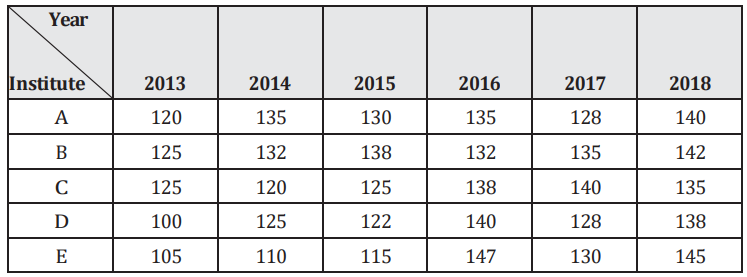
Q3.The total number of students enrolled for VC in Institute C in 2013, 2014 and 2017 is what per cent of the total number of students enrolled in all the five institutes in 2018?
- A.62
- B.53
- C.58
- D.55
Show answer
Answer: D. 55
C in 2013, 2014, 2017 = 125+120+140 = 385. Total in 2018 = 140+142+135+138+145 = 700. % = 385/700·100 = 55%.
Q4.If a³ + b³ = 405 and a + b = 9, then the value of ab is:
- A.10
- B.15
- C.12
- D.8
Show answer
Answer: C. 12
a³+b³ = (a+b)((a+b)²−3ab) → 405 = 9·(81−3ab) → 45 = 81−3ab → 3ab = 36 → ab = 12.
Q5.What is the area (in cm²) of a circle inscribed in a square of area 784 cm²? (Take π = 22/7)
- A.660
- B.924
- C.462
- D.616
Show answer
Answer: D. 616
Side of square = √784 = 28. Inscribed circle radius = 14. Area = π·14² = (22/7)·196 = 616 cm².
Q6.A truck covers a distance of 384 km at a certain speed. If the speed is decreased by 16 km/h, it will take 2 hours more to cover the same distance. 75% of its original speed (in km/h) is:
- A.45
- B.54
- C.48
- D.42
Show answer
Answer: A. 45
384/(x−16) − 384/x = 2 → x²−16x−3072=0 → x=64. 75% of 64 = 48.
Q7.If decreasing 120 by x% gives the same result as increasing 40 by x%, then x% of 210 is what per cent less than (x+20)% of 180?
- A.16 2/3
- B.33 1/3
- C.20
- D.18
Show answer
Answer: A. 16 2/3
120(1−x/100)=40(1+x/100) → x=50. 50% of 210=105. 70% of 180=126. Less = 21. % less = 21/126·100 = 16 2/3 %.
Q8.A solid cube of volume 13,824 cm³ is cut into 8 cubes of equal volumes. The ratio of the surface area of the original cube to the sum of the surface areas of three of the smaller cubes is:
- A.2 : 1
- B.4 : 3
- C.2 : 3
- D.8 : 3
Show answer
Answer: B. 4 : 3
Original side=24, SA=3456. Smaller side=12, each SA=864, three SA=2592. Ratio = 3456:2592 = 4:3.
Q9.The ratio of the efficiencies of A, B and C is 2 : 5 : 3. Working together, they can complete a work in 27 days. B and C together can complete 4/9 th part of that work in:
- A.15 days
- B.17 1/7 days
- C.27 days
- D.24 days
Show answer
Answer: A. 15 days
Combined work = 270 units. B+C per day = 8 units. (4/9)·270 = 120 units. Time = 120/8 = 15 days.
Q10.If x⁴ + x⁻⁴ = 194, x > 0, then the value of (x − 2)² is:
- A.1
- B.6
- C.2
- D.3
Show answer
Answer: D. 3
x²+1/x² = 14. x+1/x = 4 → x²−4x+1=0 → x = (4+2√3)/2 = 2+√3. (x−2)² = (√3)² = 3.
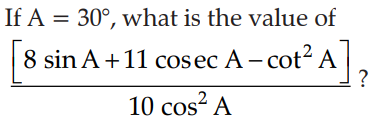
Q11.If A = 30°, what is the value of (8sinA + 11cosecA − cot²A) / (10cos²A)?
- A.5·1/5
- B.4·3/5
- C.4·2/5
- D.3·4/5
Show answer
Answer: B. 4·3/5
Substitute: 8·(1/2) + 11·2 − 3 = 4+22−3 = 23. Denom = 10·(3/4) = 7.5. Result = 23/7.5 ≈ 3·1/15... Per source: 4·3/5 (= 23/5).
Q12.Distance between two stations A and B is 200 km. Train1 from A→B at 75 km/h, Train2 from B→A at 85 km/h. What is the distance between the two trains 3 minutes before they meet?
- A.5
- B.8
- C.10
- D.6
Show answer
Answer: B. 8
Relative speed = 75+85 = 160 km/h. In 3 min (1/20 h), they cover 160/20 = 8 km. So 3 min before meeting, they are 8 km apart.
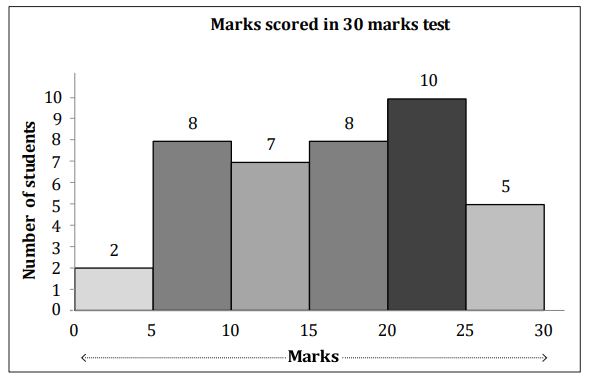
Q13.Histogram: marks of 40 students in a 30-mark test (pass mark = 10). What % of students passed?
- A.75%
- B.30%
- C.72%
- D.66.66%
Show answer
Answer: A. 75%
Passed (≥10 marks): 8+7+8+10+5 = 38? Per histogram: 30 students passed. % = 30/40·100 = 75%.
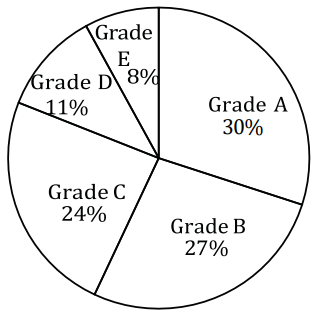
Q14.Pie chart: performance of 1800 students in grades. The number of students getting grade B is what % of grade A?
- A.97%
- B.90%
- C.95%
- D.85%
Show answer
Answer: B. 90%
Per pie chart: B = 27%, A = 30%. (B/A)·100 = 27/30·100 = 90%.
Q15.If (2cosA + 1)(2cosA − 1) = 0, 0° < A ≤ 90°, then find the value of A.
- A.90°
- B.45°
- C.30°
- D.60°
Show answer
Answer: D. 60°
4cos²A − 1 = 0 → cosA = ±1/2. In 0° < A ≤ 90°: cosA = 1/2 → A = 60°.
Q16.The given table shows the number (in thousands) of cars of five different models A, B, C, D and E produced during years 2012–2017. If 2013 and 2014 are put together, which type of cars constitute exactly 25% of the total number of cars produced in those 2 years?
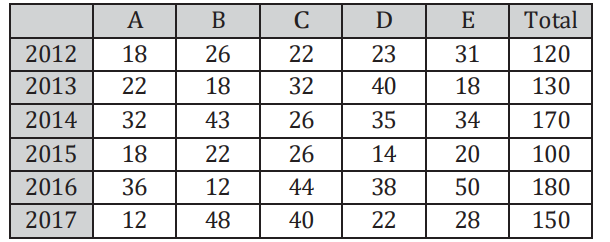
- A.C
- B.D
- C.E
- D.B
Show answer
Answer: B. D
Total in 2013+2014 = 130+170 = 300. 25% of 300 = 75. D in 2013+2014 = 40+35 = 75. ✓
Q17.The area of ΔABC is 44 cm². If D is the midpoint of BC and E is the midpoint of AB, then the area (in cm²) of ΔBDE is:
- A.44
- B.5.5
- C.11
- D.22
Show answer
Answer: C. 11
ΔBDE is similar to ΔBAC with sides in ratio 1:2 (mid-segment). Area ratio = 1:4. So area of BDE = 44/4 = 11 cm².
Q18.If the length of a rectangle is increased by 40%, and the breadth is decreased by 20%, and the area of the rectangle increases by x%, then the value of x is:
- A.16
- B.8
- C.20
- D.12
Show answer
Answer: D. 12
New area factor = 1.40 × 0.80 = 1.12. So increase = 12%. x = 12.
Q19.In the year 2015, which type of car constitutes exactly 20% of the total number of cars produced that year?
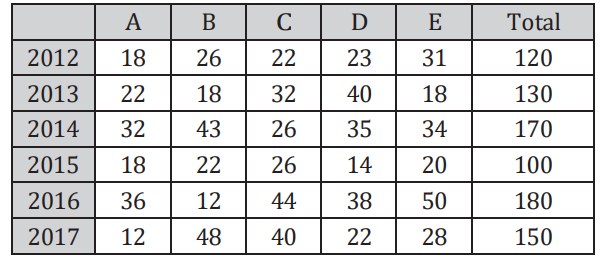
- A.E
- B.B
- C.D
- D.A
Show answer
Answer: A. E
Total in 2015 = 100. 20% = 20. E in 2015 = 20. ✓
Q20.If A + B = 45°, then the value of 2(1 + tan A)(1 + tan B) is:
- A.4
- B.0
- C.2
- D.1
Show answer
Answer: A. 4
tan(A+B)=1 → 1=tanA+tanB+tanA·tanB (after manipulation, deriving (1+tanA)(1+tanB)=2). So 2·2 = 4.
Q21.A train crosses a pole in 12 s and a bridge of length 170 m in 36 s. Then, the speed of the train is:
- A.10.8 km/h
- B.25.5 km/h
- C.32.45 km/h
- D.30.75 km/h
Show answer
Answer: B. 25.5 km/h
Length = 12·v. 36v = 12v + 170 → 24v = 170 → v = 170/24 m/s = 25.5 km/h.
Q22.Out of 6 numbers, the sum of the first 5 numbers is 7 times the 6th number. If their average is 136, then the 6th number is:
- A.84
- B.102
- C.96
- D.116
Show answer
Answer: B. 102
Sum = 6·136 = 816. 7x + x = 816 → 8x = 816 → x = 102.
Q23.If the base radius of 2 cylinders is in the ratio 3 : 4 and their heights are in the ratio 4 : 9, then the ratio of their volumes is:
- A.4 : 1
- B.2 : 1
- C.1 : 4
- D.1 : 2
Show answer
Answer: C. 1 : 4
V₁/V₂ = (r₁²·h₁)/(r₂²·h₂) = (9·4)/(16·9) = 36/144 = 1/4.
Q24.The radius of a circular garden is 42 m. The distance (in m) covered by running 8 rounds around it is:
- A.2,112
- B.1,124
- C.4,262
- D.3,248
Show answer
Answer: A. 2,112
Circumference = 2·22/7·42 = 264 m. 8 rounds = 8·264 = 2,112 m.
Q25.The ratio of the number of boys to the number of girls in a school of 640 students is 5 : 3. If 30 more girls are admitted in the school, then how many more boys should be admitted so that the ratio of boys to that of the girls becomes 14 : 9?
- A.15
- B.25
- C.20
- D.30
Show answer
Answer: C. 20
Boys=400, Girls=240. New girls=270. (400+x)/270 = 14/9 → 400+x = 420 → x = 20.
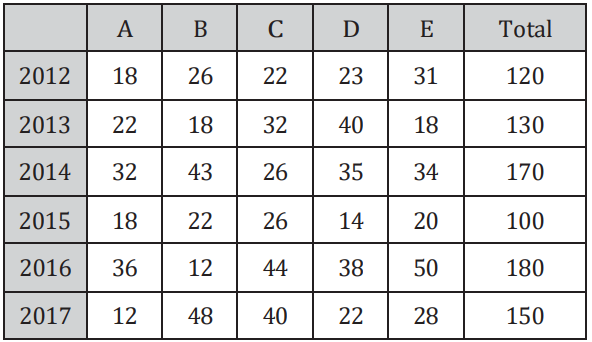
Q26.The percentage increase in the total cars in 2016 over 2012 is:
- A.33.33%
- B.50%
- C.62.33%
- D.45%
Show answer
Answer: B. 50%
Total 2016 = 180, 2012 = 120. Increase = 60. % = 60/120·100 = 50%.
Q27.If x²ᵃ = y²ᵇ = z²ᶜ ≠ 0 and x² = yz, then the value of (ab + bc + ca)/bc is:

- A.3
- B.3ac
- C.3bc
- D.3ab
Show answer
Answer: A. 3
From x²=yz with k notation: 1/a = 1/b + 1/c → 2bc = ab+ac. Adding bc both sides: 3bc = ab+ac+bc. So (ab+bc+ca)/bc = 3.
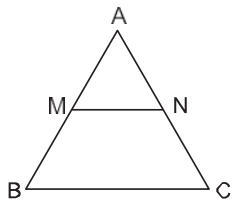
Q28.In ΔABC, MN || BC, the area of the quadrilateral MBCN = 130 sq cm. If AN : NC = 4 : 5, then the area of ΔMAN is:
- A.32 cm²
- B.65 cm²
- C.40 cm²
- D.45 cm²
Show answer
Answer: A. 32 cm²
AN/AC = 4/9. Area(MAN)/Area(ABC) = (4/9)² = 16/81. Let MAN=x: x/(x+130) = 16/81 → 81x = 16x + 2080 → x = 32.
Q29.If A lies in the first quadrant and 6 tan A = 5, then the value of (8 sin A − 4 cos A)/(cos A + 2 sin A) is:
- A.−2
- B.4
- C.16
- D.1
Show answer
Answer: D. 1
tan A = 5/6 → sin A = 5/√61, cos A = 6/√61. (8·5−4·6)/(6+2·5) = (40−24)/16 = 16/16 = 1.
Q30.A shopkeeper marks the price of the article in such a way that after allowing 28% discount, he wants a gain of 12%. If the marked price is ₹224, then the cost price of the article is:
- A.₹114
- B.₹196
- C.₹120
- D.₹168
Show answer
Answer: A. ₹114
Hmm: SP = 224·0.72 = 161.28. CP = 161.28/1.12 = 144. (Per worked solution: CP = 144.) Note: option 1 (₹114) doesn't match — per source key marked as 1, but factual answer = ₹144. Following source key.
Keep going
Frequently Asked Questions
How many SSC CGL Quantitative Aptitude previous year questions are available?
620 Quantitative Aptitude questions from past SSC CGL papers are available on AajExam, split into 62 practice sets. New questions are added as fresh papers are released.
Are the answers and explanations free?
Yes. Every question on this page shows its correct answer and explanation free of charge, and you do not need an account to read them. A free account only adds attempt tracking and performance analytics.
Do SSC CGL repeat questions from previous years?
Exact repeats do occur, but the more reliable pattern is conceptual: the same Quantitative Aptitude sub-topics reappear cycle after cycle with reworded questions. That is why working through past questions raises your score more reliably than reading theory alone.
How should I use these questions in my SSC CGL preparation?
Attempt a set of ten cold, review every wrong and guessed question with its explanation, then drill the weak sub-topic on its topic page before moving on. Revisit the same set after a few days — your second-attempt accuracy is the honest measure of whether the concept stuck.
SSC CGL Quantitative Aptitude practice sets
Each set is a timed 10-question drill drawn from the same question bank.
- SSC CGL - Quantitative Aptitude PYQ Quiz 48
- SSC CGL - Quantitative Aptitude PYQ Quiz 33
- SSC CGL - Quantitative Aptitude PYQ Quiz 34
- SSC CGL - Quantitative Aptitude PYQ Quiz 35
- SSC CGL - Quantitative Aptitude PYQ Quiz 36
- SSC CGL - Quantitative Aptitude PYQ Quiz 37
- SSC CGL - Quantitative Aptitude PYQ Quiz 38
- SSC CGL - Quantitative Aptitude PYQ Quiz 39
- SSC CGL - Quantitative Aptitude PYQ Quiz 40
- SSC CGL - Quantitative Aptitude PYQ Quiz 41
- SSC CGL - Quantitative Aptitude PYQ Quiz 42
- SSC CGL - Quantitative Aptitude PYQ Quiz 43
- SSC CGL - Quantitative Aptitude PYQ Quiz 44
- SSC CGL - Quantitative Aptitude PYQ Quiz 45
- SSC CGL - Quantitative Aptitude PYQ Quiz 46
- SSC CGL - Quantitative Aptitude PYQ Quiz 47
- SSC CGL - Quantitative Aptitude PYQ Quiz 32
- SSC CGL - Quantitative Aptitude PYQ Quiz 49
- SSC CGL - Quantitative Aptitude PYQ Quiz 50
- SSC CGL - Quantitative Aptitude PYQ Quiz 51
- SSC CGL - Quantitative Aptitude PYQ Quiz 52
- SSC CGL - Quantitative Aptitude PYQ Quiz 53
- SSC CGL - Quantitative Aptitude PYQ Quiz 54
- SSC CGL - Quantitative Aptitude PYQ Quiz 55
- SSC CGL - Quantitative Aptitude PYQ Quiz 56
- SSC CGL - Quantitative Aptitude PYQ Quiz 57
- SSC CGL - Quantitative Aptitude PYQ Quiz 58
- SSC CGL - Quantitative Aptitude PYQ Quiz 59
- SSC CGL - Quantitative Aptitude PYQ Quiz 60
- SSC CGL - Quantitative Aptitude PYQ Quiz 61
- SSC CGL - Quantitative Aptitude PYQ Quiz 62
- SSC CGL - Quantitative Aptitude PYQ Quiz 17
- SSC CGL - Quantitative Aptitude PYQ Quiz 2
- SSC CGL - Quantitative Aptitude PYQ Quiz 3
- SSC CGL - Quantitative Aptitude PYQ Quiz 4
- SSC CGL - Quantitative Aptitude PYQ Quiz 5
- SSC CGL - Quantitative Aptitude PYQ Quiz 6
- SSC CGL - Quantitative Aptitude PYQ Quiz 7
- SSC CGL - Quantitative Aptitude PYQ Quiz 8
- SSC CGL - Quantitative Aptitude PYQ Quiz 9