NEET Zoology — Previous Year Questions
200 Zoology questions asked in past NEET papers, split into 20 timed practice sets — every question with its answer and explanation.
About NEET Zoology previous year questions
Zoology PYQs asked in NEET
A sample of 30 questions from the full bank of 200. Try each one before opening the solution — the remaining questions are in the timed practice sets below.
Q1.Pathogenic bacteria gain resistance to antibiotics due to changes in their :
- A.Cosmids
- B.Plasmids
- C.Nucleus
- D.Nucleoid
Show answer
Answer: B. Plasmids
Q2.Milk of transgenic 'Cow Rosie' was nutritionally more balanced product for human babies than natural cow milk because it contained:
- A.Human protein α–1–antitrypsin
- B.Human alpha–lactalbumin
- C.Human insulin–like growth factor
- D.Human enzyme Adenosine Deaminase (ADA)
Show answer
Answer: B. Human alpha–lactalbumin
Q3.If the pH in lysosomes is increased to alkaline, what will be the outcome?
- A.Hydrolytic enzymes will function more efficiently
- B.Hydrolytic enzymes will become inactive
- C.Lysosomal enzymes will be released into the cytoplasm
- D.Lysosomal enzymes will be more active
Show answer
Answer: B. Hydrolytic enzymes will become inactive
Q4.Choose the incorrect enzymatic reaction :
- A.Maltose Maltase → Glucose + Galactose
- B.Sucrose Sucrase → Glucose + Fructose
- C.Lactose Lactase → Glucose + Galactose
- D.Dipeptides Dipeptidases → Amino acids
Show answer
Answer: A. Maltose Maltase → Glucose + Galactose
Q5.Which of the following reasons in mainly responsible for graft rejection in transplantation of organs ?
- A.Inability of recipient to differentiate between 'self and 'non–self' tissues/cells
- B.Humoral immune response only
- C.Auto–immune response
- D.Cell–mediated response
Show answer
Answer: D. Cell–mediated response
Q6.If DNA contained sulphur instead of phosphorus and proteins contained phosphorus instead of sulfur, what would have been the outcome of Hershey and Chase experiment?
- A.No radioactive sulfur in bacterial cells
- B.Both radioactive sulfur and phosphorus in bacterial cells
- C.Radioactive sulfur in bacterial cells
- D.Radioactive phosphorus in bacterial cells
Show answer
Answer: C. Radioactive sulfur in bacterial cells
Q7.Two butterfly species are competing for the same nectar of a flower in a garden. To survive and coexist together, they may avoid competition in the same garden by:
- A.feeding at the same time
- B.choosing different foraging patterns
- C.increasing time spent on attacking each other
- D.predating on each other
Show answer
Answer: B. choosing different foraging patterns
Q8.Mad cow disease in cattle and Cr Jacob disease in humans are due to infection by_________ .
- A.Bacterium
- B.Virus
- C.Viroid
- D.Prion
Show answer
Answer: D. Prion
Q9.Which of the following is not an Intra Uterine device?
- A.Progestogens
- B.Multiload 375
- C.Lippes loop
- D.Progestasert
Show answer
Answer: A. Progestogens
Q10.Match List–I with List-II : List - I List - II
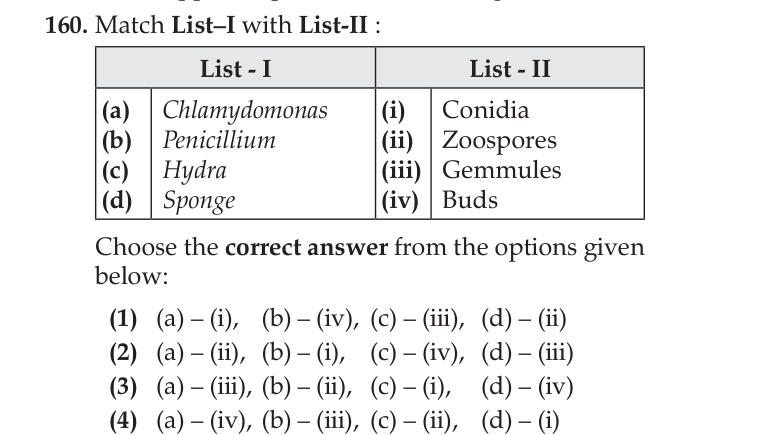
- A.(A)
- B.(B)
- C.(C)
- D.(D)
Show answer
Answer: B. (B)
Q11.Which one of the following statements about Histones is wrong ?
- A.Histones carry positive charge in the side chain.
- B.Histones are organized to form a unit of 8 molecules.
- C.The pH of histones is slightly acidic.
- D.Histones are rich in amino acids - Lysine and Arginine.
Show answer
Answer: C. The pH of histones is slightly acidic.
Q12.Assertion (A): A person goes to high altitude and experiences ‘altitude sickness’ with symptoms like breathing difficulty and heart palpitations. Reason (R): Due to low atmospheric pressure at high altitude, the body does not get sufficient oxygen. In the light of the above statements, choose the correct answer from the options given below
- A.(A) is false but (R) is true
- B.Both (A) and (R) are true and (R) is the correct explanation of (A)
- C.Both (A) and (R) are true but (R) is not the correct explanation of (A)
- D.(A) is true but (R) is false
Show answer
Answer: B. Both (A) and (R) are true and (R) is the correct explanation of (A)
Q13.Which of the following is not a step in Multiple Ovulation Embryo Transfer Technology (MOET) ?
- A.Fertilized eggs are transferred to surrogate mothers at 8-32 cell stage.
- B.Cow is administered hormone having LH like activity for super ovulation.
- C.Cow yields about 6-8 eggs at a time.
- D.Cow is fertilized by artificial insemination.
Show answer
Answer: B. Cow is administered hormone having LH like activity for super ovulation.
Q14.Match List-I with List-II List-I List-II
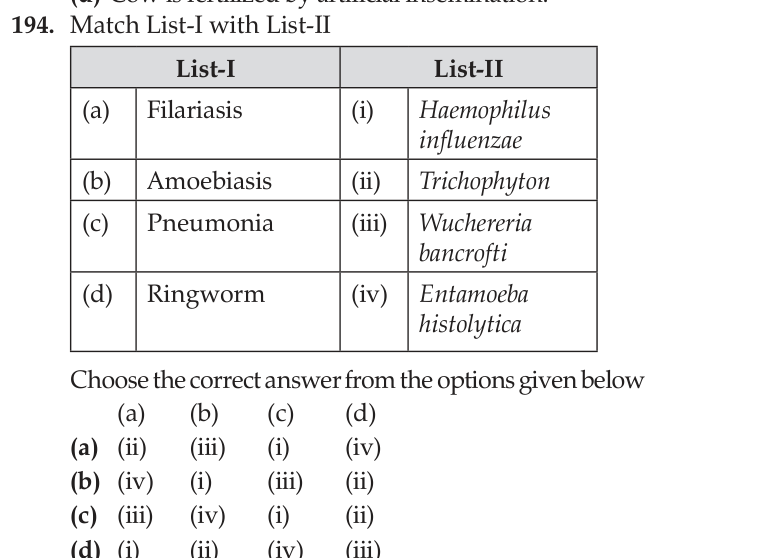
- A.(A)
- B.(B)
- C.(C)
- D.(D)
Show answer
Answer: C. (C)
Q15.Following are the statements with reference to ‘lipids’.
- A.Lipids having only single bonds are called unsaturated fatty acids.
- B.Lecithin is a phospholipid.
- C.Trihydroxy propane is glycerol.
- D.Palmitic acid has 20 carbon atoms including carboxyl carbon. (e) Arachidonic acid has 16 carbon atoms. Choose the correct answer from the options given below.
Show answer
Answer: D. Palmitic acid has 20 carbon atoms including carboxyl carbon. (e) Arachidonic acid has 16 carbon atoms. Choose the correct answer from the options given below.
Q16.Which of the following secretes the hormone, relaxin, during the later phase of pregnancy ?
- A.Uterus
- B.Graafian follicle
- C.Corpus luteum
- D.Foetus
Show answer
Answer: C. Corpus luteum
Q17.Identify the types of cell junctions that help to stop the leakage of the substances across a tissue and facilitation of communication with neighbouring cells via rapid transfer of ions and molecules.
- A.Adhering junctions and Gap junctions, respectively.
- B.Gap junctions and Adhering junctions, respectively.
- C.Tight junctions and Gap junctions, respectively.
- D.Adhering junctions and Tight junctions, respectively.
Show answer
Answer: C. Tight junctions and Gap junctions, respectively.
Q18.Match List-I with List-II List-I List-II
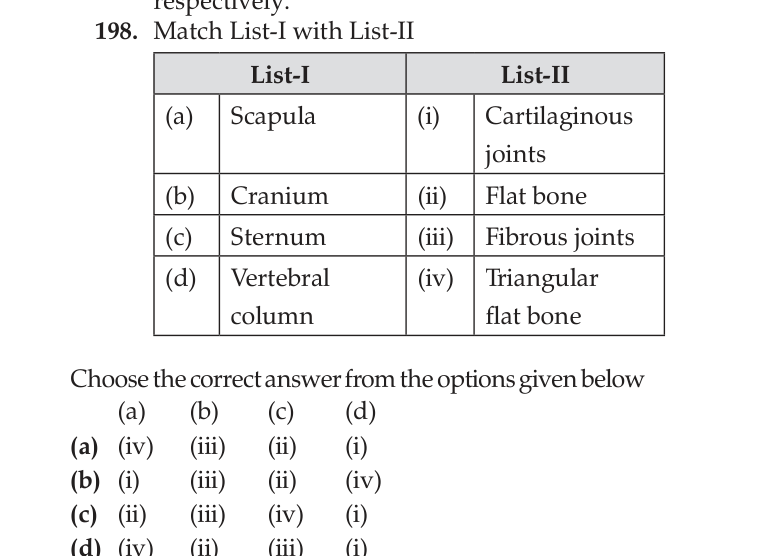
- A.(A)
- B.(B)
- C.(C)
- D.(D)
Show answer
Answer: A. (A)
Q19.During muscular contraction which of the following events occur ?
- A.‘H’ zone disappears
- B.‘A’ band widens
- C.‘I’ band reduces in width
- D.Myosine hydrolyzes ATP, releasing the ADP and Pi. (e) Z-lines attached to actins are pulled inwards. Choose the correct answer from the options given below
Show answer
Answer: B. ‘A’ band widens
Q20.Statement I: The codon ‘AUG’ codes for methionine and phenylalanine. Statement II: ‘AAA’ and ‘AAG’ both codons code for the amino acid lysine. In the light of the above statements, choose the correct answer from the options given below.
- A.Statement I is incorrect but Statement II is true.
- B.Both Statement I and Statement II are true.
- C.Both Statement I and Statement II are false.
- D.Statement I is correct but Statement II is false. A B C D E F G H I J S V A C 1 2 0 1 2 3 4 5 6 7 8 9 0 1 2 3 4 5 6 7 8 9 0 1 2 3 4 5 6 7 8 9 0 1 2 3 4 5 6 7 8 9 0 1 2 3 4 5 6 7 8 9 0 1 2 3 4 5 6 7 8 9 0 1 2 3 4 5 6 7 8 9 0 1 2 3 4 5 6 7 8 9 0 1 2 3 4 5 6 7 8 9 10+1 10-2 10-3 Crash Paper Paper 1 Paper 2 Name Test Date Marking Code 0 1 2 3 4 5 6 7 8 9 0 1 2 3 4 5 6 7 8 9 1 2 3 4 a b c d a b c d a b c d a b c d a b c d a b c d a b c d a b c d a b c d a b c d 5 6 7 8 9 a b c d a b c d a b c d a b c d a b c d a b c d a b c d a b c d a b c d a b c d a b c d a b c d a b c d a b c d a b c d a b c d a b c d a b c d a b c d a b c d a b c d a b c d a b c d a b c d a b c d a b c d a b c d a b c d a b c d a b c d a b c d a b c d a b c d a b c d a b c d a b c d a b c d a b c d a b c d a b c d a b c d a b c d a b c d a b c d a b c d a b c d a b c d a b c d a b c d a b c d a b c d a b c d a b c d a b c d a b c d a b c d a b c d a b c d a b c d a b c d a b c d a b c d a b c d a b c d a b c d a b c d a b c d a b c d a b c d a b c d a b c d a b c d a b c d a b c d a b c d a b c d a b c d a b c d a b c d a b c d a b c d a b c d a b c d a b c d a b c d a b c d a b c d a b c d a b c d a b c d a b c d a b c d a b c d a b c d a b c d a b c d a b c d a b c d a b c d a b c d a b c d a b c d a b c d a b c d a b c d a b c d a b c d a b c d a b c d a b c d a b c d a b c d a b c d a b c d a b c d a b c d a b c d a b c d a b c d a b c d a b c d a b c d a b c d a b c d a b c d a b c d a b c d a b c d a b c d a b c d a b c d a b c d a b c d a b c d a b c d a b c d a b c d a b c d a b c d a b c d a b c d a b c d a b c d a b c d a b c d a b c d a b c d a b c d a b c d a b c d a b c d a b c d a b c d a b c d a b c d a b c d a b c d a b c d a b c d a b c d a b c d a b c d a b c d a b c d a b c d a b c d a b c d a b c d a b c d a b c d a b c d a b c d a b c d a b c d a b c d a b c d a b c d a b c d a b c d a b c d a b c d a b c d a b c d a b c d a b c d a b c d a b c d a b c d a b c d a b c d
Show answer
Answer: A. Statement I is incorrect but Statement II is true.
Q21.Which one of the following belongs to the family Muscidae ?
- A.House fly
- B.Fire fly
- C.Grasshopper
- D.Cockroach
Show answer
Answer: A. House fly
Q22.Veneral diseases can spread through
- A.Using sterile needles
- B.Transfusion of blood from infected person
- C.Infected mother to foetus
- D.Kissing (e) Inheritance Choose the correct answer from the option given below
Show answer
Answer: D. Kissing (e) Inheritance Choose the correct answer from the option given below
Q23.The partial pressures (in mm Hg) of oxygen (O₂) and carbon dioxide (CO₂) at alveoli (the site of diffusion) are
- A.pO₂ = 159 and pCO₂ = 0.3
- B.pO₂ = 104 and pCO₂ = 40
- C.pO₂ = 40 and pCO₂ = 45
- D.pO₂ = 95 and pCO₂ = 40
Show answer
Answer: B. pO₂ = 104 and pCO₂ = 40
Q24.Which one of the following is an example of hormone releasing IUD ?
- A.Multiload 375
- B.CuT
- C.LNG 20
- D.Cu 7
Show answer
Answer: C. LNG 20
Q25.Which stage of meiotic prophase shows terminalisation of chiasmata as its distinctive feature ?
- A.Pachytene
- B.Leptotene
- C.Zygotene
- D.Diakinesis
Show answer
Answer: D. Diakinesis
Q26.Which of these is not an important component of initiation of parturition in humans ?
- A.Release of Prolactin
- B.Increase in estrogen and progesterone ratio
- C.Synthesis of prostaglandins
- D.Release of Oxytocin
Show answer
Answer: A. Release of Prolactin
Q27.Following are the statements about prostomium of earthworm.
- A.It serves as a covering for mouth.
- B.It helps to open cracks in the soil into which it can crawl.
- C.It is one of the sensory structures.
- D.It is the first body segment. Choose the correct answer from the options given below.
Show answer
Answer: B. It helps to open cracks in the soil into which it can crawl.
Q28.The Adenosine deaminase deficiency results into
- A.Addison's disease
- B.Dysfunction of Immune system
- C.Parkinson's disease
- D.Digestive disorder
Show answer
Answer: B. Dysfunction of Immune system
Q29.Match List-I with List-II List-I List-II
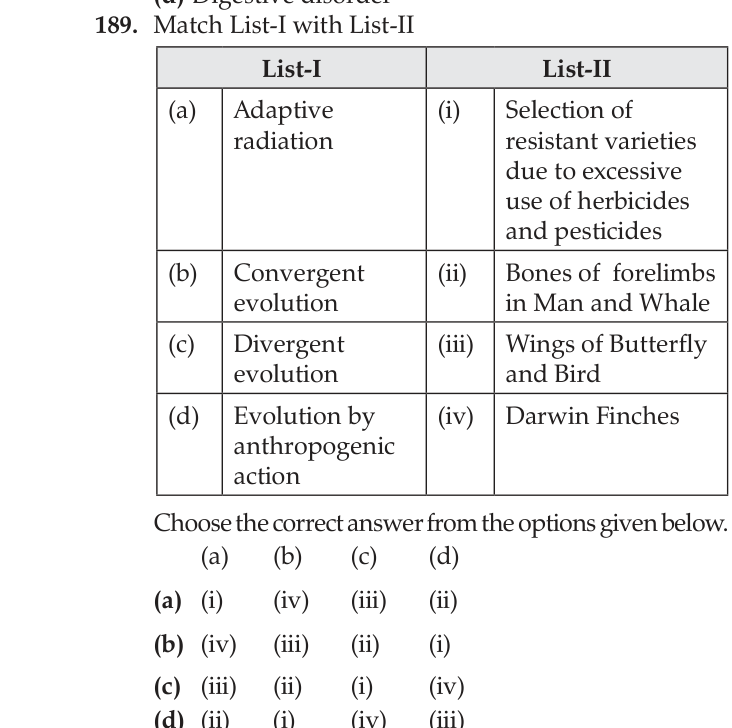
- A.(A)
- B.(B)
- C.(C)
- D.(D)
Show answer
Answer: B. (B)
Q30.Match List-I with List-II List-I List-II
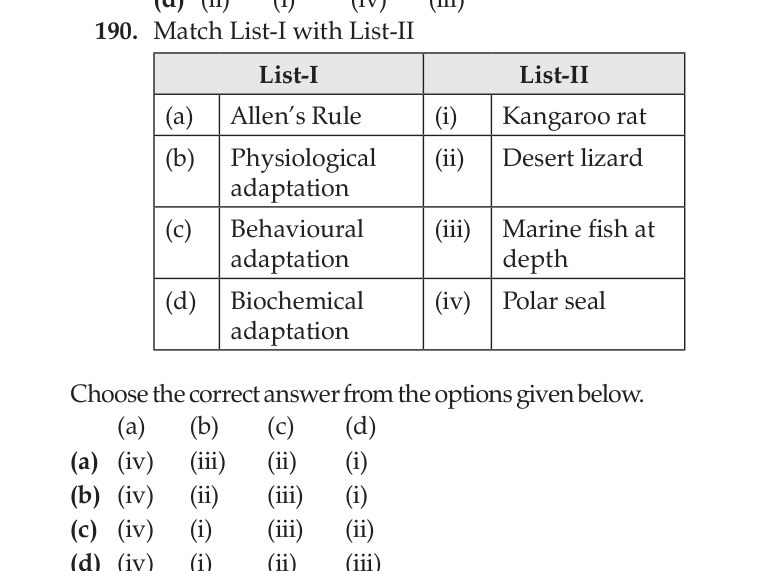
- A.(A)
- B.(B)
- C.(C)
- D.(D)
Show answer
Answer: D. (D)
Keep going
Frequently Asked Questions
How many NEET Zoology previous year questions are available?
200 Zoology questions from past NEET papers are available on AajExam, split into 20 practice sets. New questions are added as fresh papers are released.
Are the answers and explanations free?
Yes. Every question on this page shows its correct answer and explanation free of charge, and you do not need an account to read them. A free account only adds attempt tracking and performance analytics.
Do NEET repeat questions from previous years?
Exact repeats do occur, but the more reliable pattern is conceptual: the same Zoology sub-topics reappear cycle after cycle with reworded questions. That is why working through past questions raises your score more reliably than reading theory alone.
How should I use these questions in my NEET preparation?
Attempt a set of ten cold, review every wrong and guessed question with its explanation, then drill the weak sub-topic on its topic page before moving on. Revisit the same set after a few days — your second-attempt accuracy is the honest measure of whether the concept stuck.
NEET Zoology practice sets
Each set is a timed 10-question drill drawn from the same question bank.
- NEET - Zoology PYQ Quiz 11
- NEET - Zoology PYQ Quiz 20
- NEET - Zoology PYQ Quiz 19
- NEET - Zoology PYQ Quiz 18
- NEET - Zoology PYQ Quiz 17
- NEET - Zoology PYQ Quiz 16
- NEET - Zoology PYQ Quiz 15
- NEET - Zoology PYQ Quiz 14
- NEET - Zoology PYQ Quiz 13
- NEET - Zoology PYQ Quiz 12
- NEET - Zoology PYQ Quiz 1
- NEET - Zoology PYQ Quiz 10
- NEET - Zoology PYQ Quiz 9
- NEET - Zoology PYQ Quiz 8
- NEET - Zoology PYQ Quiz 7
- NEET - Zoology PYQ Quiz 6
- NEET - Zoology PYQ Quiz 5
- NEET - Zoology PYQ Quiz 4
- NEET - Zoology PYQ Quiz 3
- NEET - Zoology PYQ Quiz 2