NEET Physics — Previous Year Questions
740 Physics questions asked in past NEET papers, split into 74 timed practice sets — every question with its answer and explanation.
About NEET Physics previous year questions
Physics PYQs asked in NEET
A sample of 30 questions from the full bank of 740. Try each one before opening the solution — the remaining questions are in the timed practice sets below.
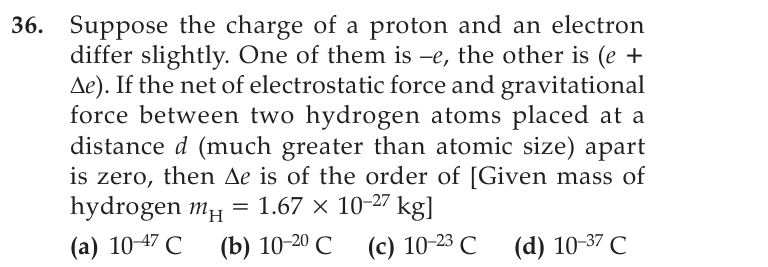
Q1.Suppose the charge of a proton and an electron differ slightly. One of them is –e, the other is (e + ∆e). If the net of electrostatic force and gravitational force between two hydrogen atoms placed at a distance d (much greater than atomic size) apart is zero, then ∆e is of the order of [Given mass of hydrogen m_(H) = 1.67 × 10⁻²⁷ kg]
- A.(A)
- B.(B)
- C.(C)
- D.(D)
Show answer
Answer: D. (D)
Q2.Two rods A and B of different materials are welded together as shown in figure. Their thermal conductivities are K₁ and K₂. The thermal conductivity of the composite rod will be T₁ T₂ d A B K₂ K₁

- A.(A)
- B.(B)
- C.(C)
- D.(D)
Show answer
Answer: B. (B)
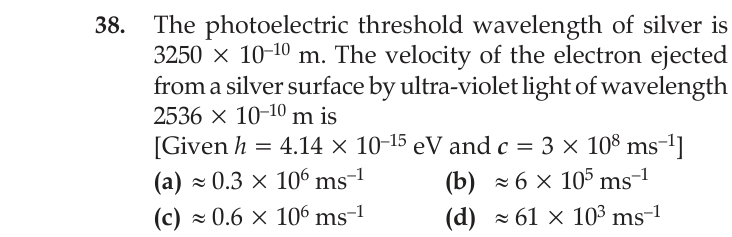
Q3.The photoelectric threshold wavelength of silver is 3250 × 10⁻¹⁰ m. The velocity of the electron ejected from a silver surface by ultra-violet light of wavelength 2536 × 10⁻¹⁰ m is [Given h = 4.14 × 10⁻¹⁵ eV and c = 3 × 10⁸ ms⁻¹]
- A.(A)
- B.(B)
- C.(C)
- D.(D)
Show answer
Answer: C. (C)
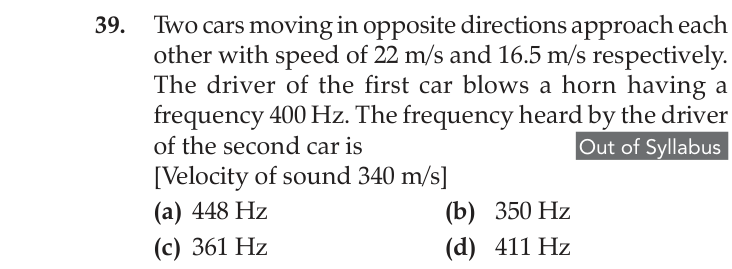
Q4.Two cars moving in opposite directions approach each other with speed of 22 m/s and 16.5 m/s respectively. The driver of the first car blows a horn having a frequency 400 Hz. The frequency heard by the driver of the second car is [Velocity of sound 340 m/s]
- A.(A)
- B.(B)
- C.(C)
- D.(D)
Show answer
Answer: A. (A)
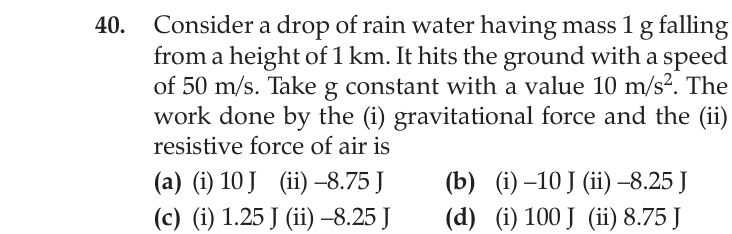
Q5.Consider a drop of rain water having mass 1 g falling from a height of 1 km. It hits the ground with a speed of 50 m/s. Take g constant with a value 10 m/s². The work done by the (i) gravitational force and the (ii) resistive force of air is
- A.(A)
- B.(B)
- C.(C)
- D.(D)
Show answer
Answer: A. (A)
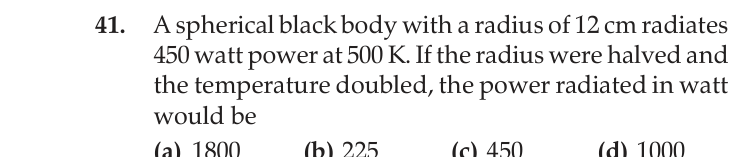
Q6.A spherical black body with a radius of 12 cm radiates 450 watt power at 500 K. If the radius were halved and the temperature doubled, the power radiated in watt would be
- A.(A)
- B.(B)
- C.(C)
- D.(D)
Show answer
Answer: A. (A)
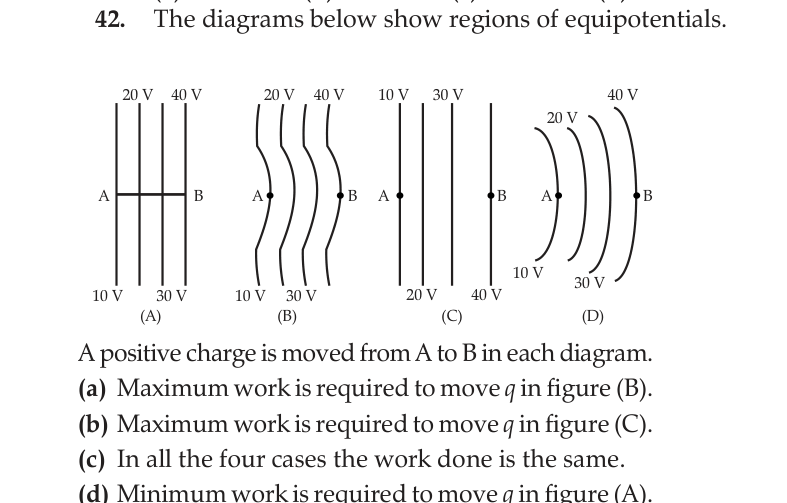
Q7.The diagrams below show regions of equipotentials. 20 V 20 V 40 V 40 V 10 V 30 V 40 V 20 V 30 V 10 V 30 V 10 V 20 V 40 V 10 V 30 V A B A B A B A B (A) (B) (C) (D) A positive charge is moved from A to B in each diagram.
- A.(A)
- B.(B)
- C.(C)
- D.(D)
Show answer
Answer: C. (C)
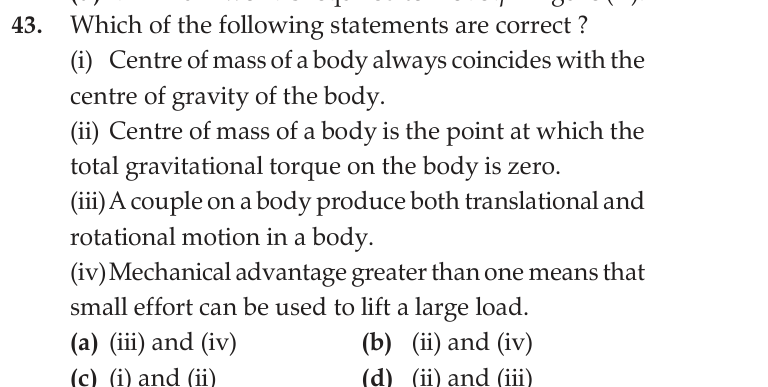
Q8.Which of the following statements are correct ? (i) Centre of mass of a body always coincides with the centre of gravity of the body. (ii) Centre of mass of a body is the point at which the total gravitational torque on the body is zero. (iii) A couple on a body produce both translational and rotational motion in a body. (iv) Mechanical advantage greater than one means that small effort can be used to lift a large load.
- A.(A)
- B.(B)
- C.(C)
- D.(D)
Show answer
Answer: B. (B)
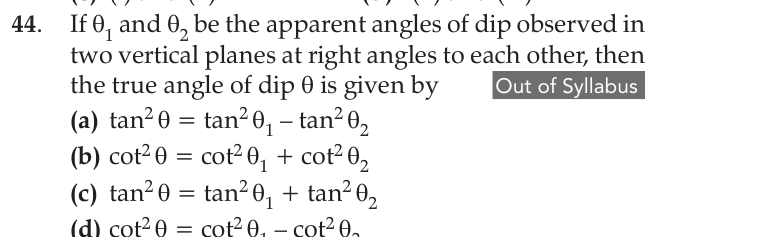
Q9.If θ₁ and θ₂ be the apparent angles of dip observed in two vertical planes at right angles to each other, then the true angle of dip θ is given by
- A.(A)
- B.(B)
- C.(C)
- D.(D)
Show answer
Answer: B. (B)
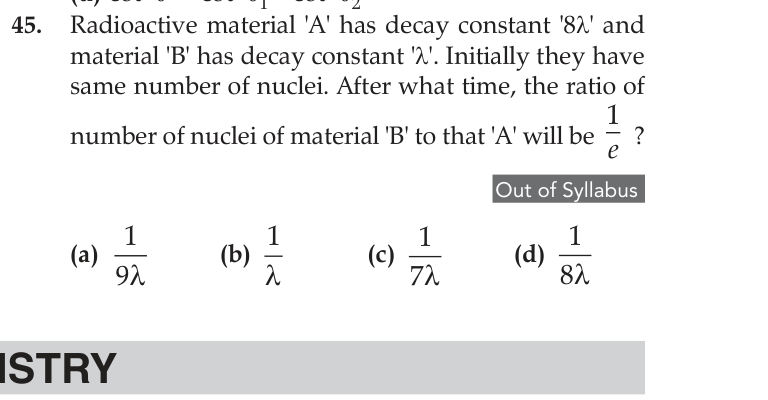
Q10.Radioactive material 'A' has decay constant '8λ' and material 'B' has decay constant 'λ'. Initially they have same number of nuclei. After what time, the ratio of number of nuclei of material 'B' to that 'A' will be 1 e ?
- A.(A)
- B.(B)
- C.(C)
- D.(D)
Show answer
Answer: C. (C)
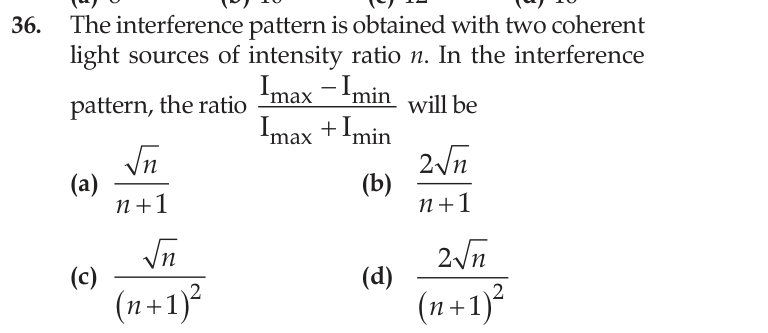
Q11.The interference pattern is obtained with two coherent light sources of intensity ratio n. In the interference pattern, the ratio I I I I max max min min will be
- A.(A)
- B.(B)
- C.(C)
- D.(D)
Show answer
Answer: B. (B)
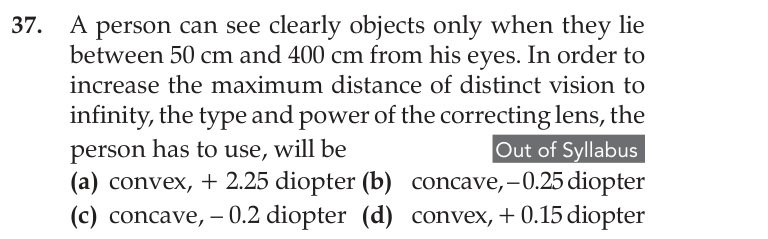
Q12.A person can see clearly objects only when they lie between 50 cm and 400 cm from his eyes. In order to increase the maximum distance of distinct vision to infinity, the type and power of the correcting lens, the person has to use, will be
- A.(A)
- B.(B)
- C.(C)
- D.(D)
Show answer
Answer: B. (B)
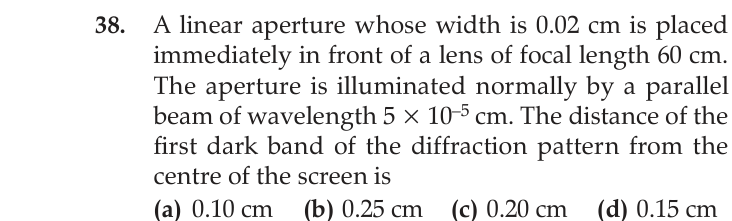
Q13.A linear aperture whose width is 0.02 cm is placed immediately in front of a lens of focal length 60 cm. The aperture is illuminated normally by a parallel beam of wavelength 5 × 10⁻⁵ cm. The distance of the first dark band of the diffraction pattern from the centre of the screen is
- A.(A)
- B.(B)
- C.(C)
- D.(D)
Show answer
Answer: D. (D)
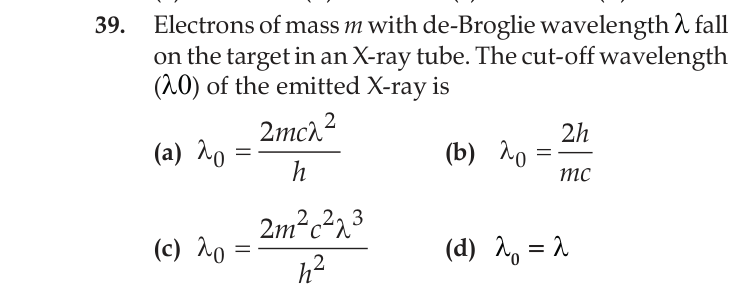
Q14.Electrons of mass m with de-Broglie wavelength λ fall on the target in an X-ray tube. The cut-off wavelength (λ0) of the emitted X-ray is
- A.(A)
- B.(B)
- C.(C)
- D.(D)
Show answer
Answer: A. (A)
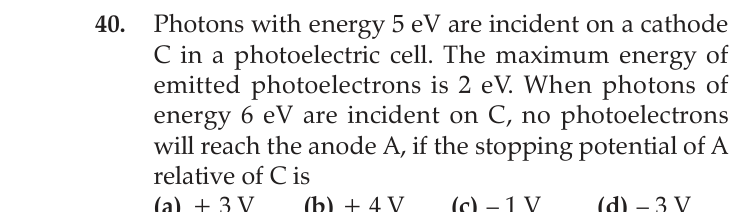
Q15.Photons with energy 5 eV are incident on a cathode C in a photoelectric cell. The maximum energy of emitted photoelectrons is 2 eV. When photons of energy 6 eV are incident on C, no photoelectrons will reach the anode A, if the stopping potential of A relative of C is
- A.(A)
- B.(B)
- C.(C)
- D.(D)
Show answer
Answer: D. (D)
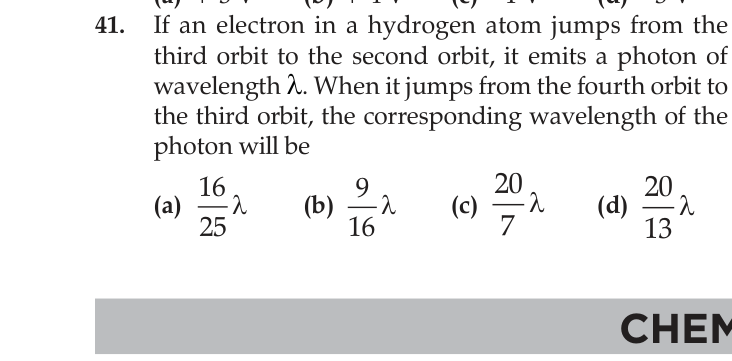
Q16.If an electron in a hydrogen atom jumps from the third orbit to the second orbit, it emits a photon of wavelength λ. When it jumps from the fourth orbit to the third orbit, the corresponding wavelength of the photon will be
- A.(A)
- B.(B)
- C.(C)
- D.(D)
Show answer
Answer: C. (C)
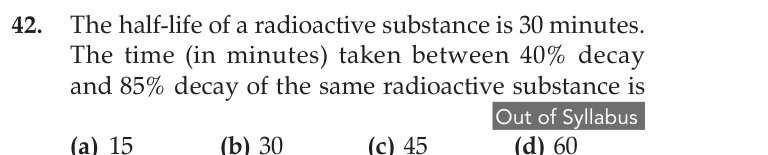
Q17.The half-life of a radioactive substance is 30 minutes. The time (in minutes) taken between 40% decay and 85% decay of the same radioactive substance is
- A.(A)
- B.(B)
- C.(C)
- D.(D)
Show answer
Answer: D. (D)
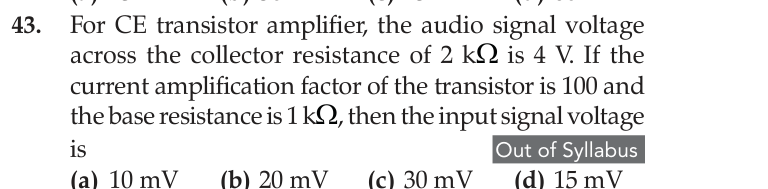
Q18.For CE transistor amplifier, the audio signal voltage across the collector resistance of 2 kΩ is 4 V. If the current amplification factor of the transistor is 100 and the base resistance is 1 kΩ, then the input signal voltage is
- A.(A)
- B.(B)
- C.(C)
- D.(D)
Show answer
Answer: B. (B)
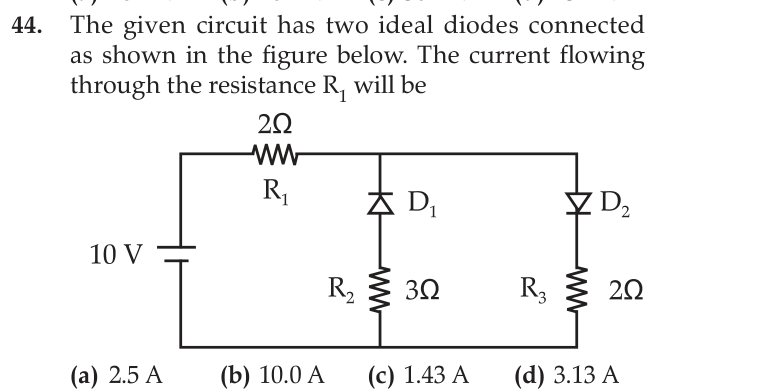
Q19.The given circuit has two ideal diodes connected as shown in the figure below. The current flowing through the resistance R₁ will be
- A.(A)
- B.(B)
- C.(C)
- D.(D)
Show answer
Answer: A. (A)
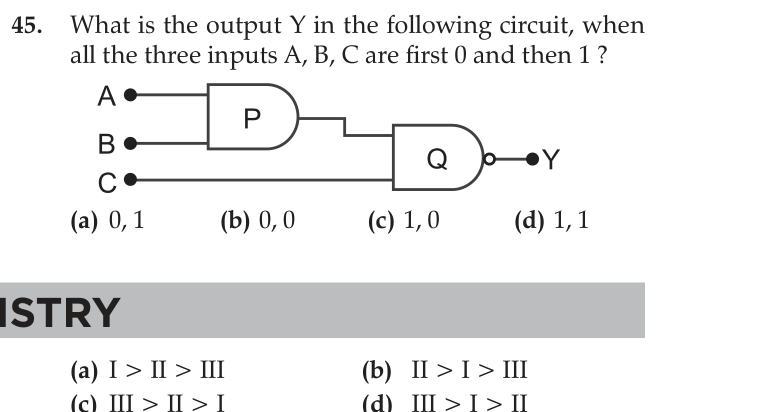
Q20.What is the output Y in the following circuit, when all the three inputs A, B, C are first 0 and then 1 ?
- A.(A)
- B.(B)
- C.(C)
- D.(D)
Show answer
Answer: C. (C)
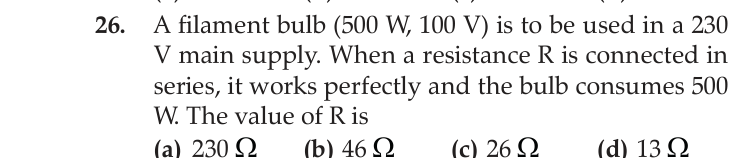
Q21.A filament bulb (500 W, 100 V) is to be used in a 230 V main supply. When a resistance R is connected in series, it works perfectly and the bulb consumes 500 W. The value of R is
- A.(A)
- B.(B)
- C.(C)
- D.(D)
Show answer
Answer: C. (C)
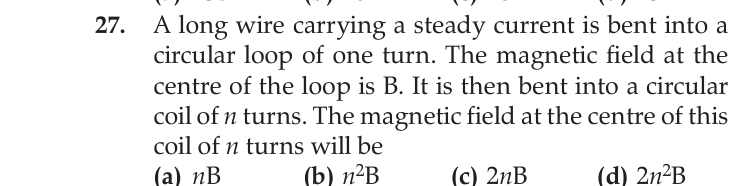
Q22.A long wire carrying a steady current is bent into a circular loop of one turn. The magnetic field at the centre of the loop is B. It is then bent into a circular coil of n turns. The magnetic field at the centre of this coil of n turns will be
- A.(A)
- B.(B)
- C.(C)
- D.(D)
Show answer
Answer: B. (B)
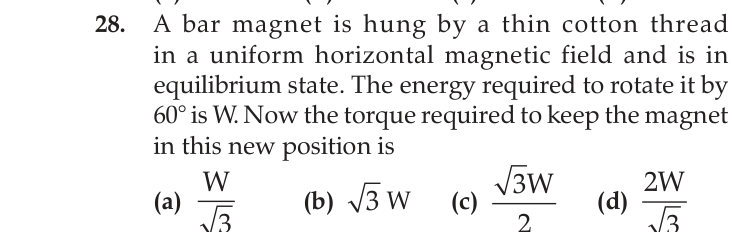
Q23.A bar magnet is hung by a thin cotton thread in a uniform horizontal magnetic field and is in equilibrium state. The energy required to rotate it by 60° is W. Now the torque required to keep the magnet in this new position is
- A.(A)
- B.(B)
- C.(C)
- D.(D)
Show answer
Answer: B. (B)
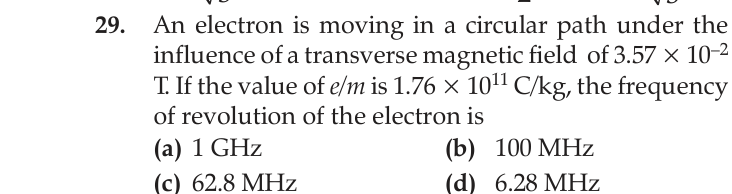
Q24.An electron is moving in a circular path under the influence of a transverse magnetic field of 3.57 × 10⁻² T. If the value of e/m is 1.76 × 10¹¹ C/kg, the frequency of revolution of the electron is
- A.(A)
- B.(B)
- C.(C)
- D.(D)
Show answer
Answer: A. (A)
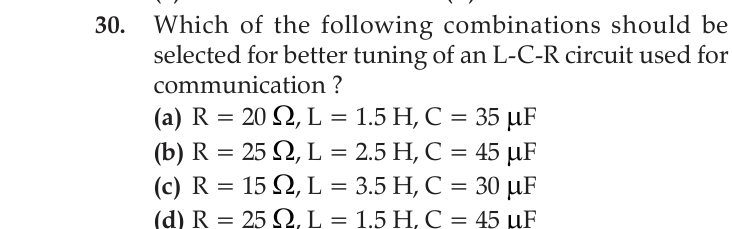
Q25.Which of the following combinations should be selected for better tuning of an L-C-R circuit used for communication ?
- A.(A)
- B.(B)
- C.(C)
- D.(D)
Show answer
Answer: C. (C)
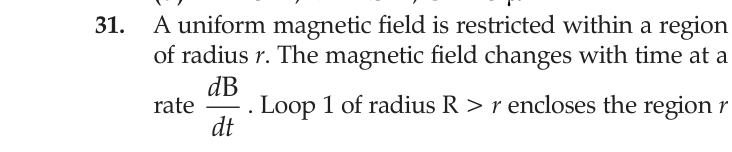
Q26.A uniform magnetic field is restricted within a region of radius r. The magnetic field changes with time at a rate d dt B . Loop 1 of radius R > r encloses the region r and loop 2 of radius R is outside the region of magnetic field as shown in the figure. Then, the emf generated is R 1 2 R
- A.(A)
- B.(B)
- C.(C)
- D.(D)
Show answer
Answer: D. (D)
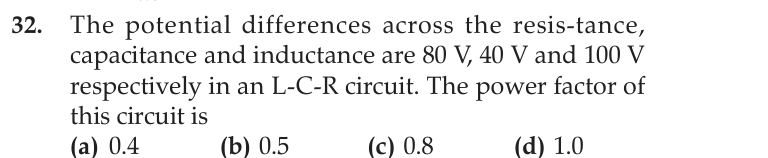
Q27.The potential differences across the resis-tance, capacitance and inductance are 80 V, 40 V and 100 V respectively in an L-C-R circuit. The power factor of this circuit is
- A.(A)
- B.(B)
- C.(C)
- D.(D)
Show answer
Answer: C. (C)
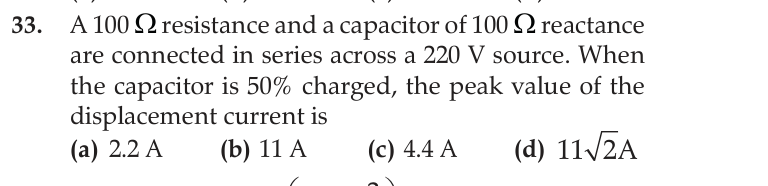
Q28.A 100 Ω resistance and a capacitor of 100 Ω reactance are connected in series across a 220 V source. When the capacitor is 50% charged, the peak value of the displacement current is
- A.(A)
- B.(B)
- C.(C)
- D.(D)
Show answer
Answer: A. (A)
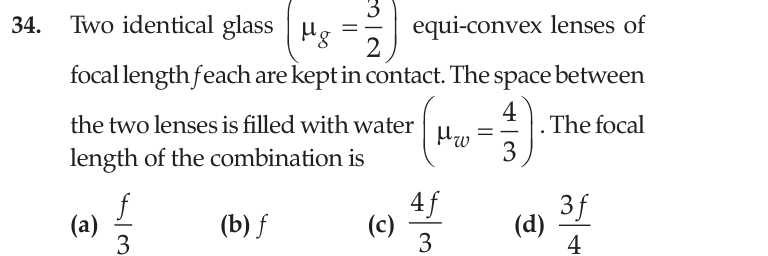
Q29.Two identical glass _(g) 3 2 equi-convex lenses of focal length f each are kept in contact. The space between the two lenses is filled with water _(w) 4 3 . The focal length of the combination is
- A.(A)
- B.(B)
- C.(C)
- D.(D)
Show answer
Answer: D. (D)
Q30.An air bubble in a glass slab with refractive index 1.5 (near normal incidence) is 5 cm deep when viewed from one surface and 3 cm deep when viewed from the opposite face. The thickness (in cm) of the slab is

- A.(A)
- B.(B)
- C.(C)
- D.(D)
Show answer
Answer: C. (C)
Keep going
Frequently Asked Questions
How many NEET Physics previous year questions are available?
740 Physics questions from past NEET papers are available on AajExam, split into 74 practice sets. New questions are added as fresh papers are released.
Are the answers and explanations free?
Yes. Every question on this page shows its correct answer and explanation free of charge, and you do not need an account to read them. A free account only adds attempt tracking and performance analytics.
Do NEET repeat questions from previous years?
Exact repeats do occur, but the more reliable pattern is conceptual: the same Physics sub-topics reappear cycle after cycle with reworded questions. That is why working through past questions raises your score more reliably than reading theory alone.
How should I use these questions in my NEET preparation?
Attempt a set of ten cold, review every wrong and guessed question with its explanation, then drill the weak sub-topic on its topic page before moving on. Revisit the same set after a few days — your second-attempt accuracy is the honest measure of whether the concept stuck.
NEET Physics practice sets
Each set is a timed 10-question drill drawn from the same question bank.
- NEET - Physics PYQ Quiz 47
- NEET - Physics PYQ Quiz 56
- NEET - Physics PYQ Quiz 55
- NEET - Physics PYQ Quiz 54
- NEET - Physics PYQ Quiz 53
- NEET - Physics PYQ Quiz 52
- NEET - Physics PYQ Quiz 51
- NEET - Physics PYQ Quiz 50
- NEET - Physics PYQ Quiz 49
- NEET - Physics PYQ Quiz 48
- NEET - Physics PYQ Quiz 57
- NEET - Physics PYQ Quiz 46
- NEET - Physics PYQ Quiz 45
- NEET - Physics PYQ Quiz 44
- NEET - Physics PYQ Quiz 43
- NEET - Physics PYQ Quiz 42
- NEET - Physics PYQ Quiz 41
- NEET - Physics PYQ Quiz 40
- NEET - Physics PYQ Quiz 39
- NEET - Physics PYQ Quiz 66
- NEET - Physics PYQ Quiz 74
- NEET - Physics PYQ Quiz 73
- NEET - Physics PYQ Quiz 72
- NEET - Physics PYQ Quiz 71
- NEET - Physics PYQ Quiz 70
- NEET - Physics PYQ Quiz 69
- NEET - Physics PYQ Quiz 68
- NEET - Physics PYQ Quiz 67
- NEET - Physics PYQ Quiz 38
- NEET - Physics PYQ Quiz 65
- NEET - Physics PYQ Quiz 64
- NEET - Physics PYQ Quiz 63
- NEET - Physics PYQ Quiz 62
- NEET - Physics PYQ Quiz 61
- NEET - Physics PYQ Quiz 60
- NEET - Physics PYQ Quiz 59
- NEET - Physics PYQ Quiz 58
- NEET - Physics PYQ Quiz 10
- NEET - Physics PYQ Quiz 19
- NEET - Physics PYQ Quiz 18