NEET Chemistry — Previous Year Questions
740 Chemistry questions asked in past NEET papers, split into 74 timed practice sets — every question with its answer and explanation.
About NEET Chemistry previous year questions
Chemistry PYQs asked in NEET
A sample of 30 questions from the full bank of 740. Try each one before opening the solution — the remaining questions are in the timed practice sets below.
Q1.HgCl₂ and I₂ both when dissolved in water containing I⁻ ions, the pair of species formed is
- A.Hg₂I₂, I⁻
- B.HgI₂, I₃ –
- C.HgI₂, I⁻
- D.HgI I 4 2 3 − − ,
Show answer
Answer: D. HgI I 4 2 3 − − ,
Q2.Extraction of gold and silver involves leaching with CN⁻ ion. Silver is later recovered by
- A.Displacement with Zn
- B.Liquation
- C.Distillation
- D.Zone refining
Show answer
Answer: A. Displacement with Zn
Q3.The correct order of the stoichiometries of AgCl formed when AgNO₃ in excess is treated with the complexes : CoCl₃·6NH₃, CoCl₃·5NH₃, CoCl₃·4NH₃ respectively is
- A.2 AgCl, 3 AgCl, 1 AgCl
- B.1 AgCl, 3 AgCl, 2 AgCl
- C.3 AgCl, 1 AgCl, 2 AgCl
- D.3 AgCl, 2 AgCl, 1 AgCl
Show answer
Answer: D. 3 AgCl, 2 AgCl, 1 AgCl
Q4.Identify A and predict the type of reaction
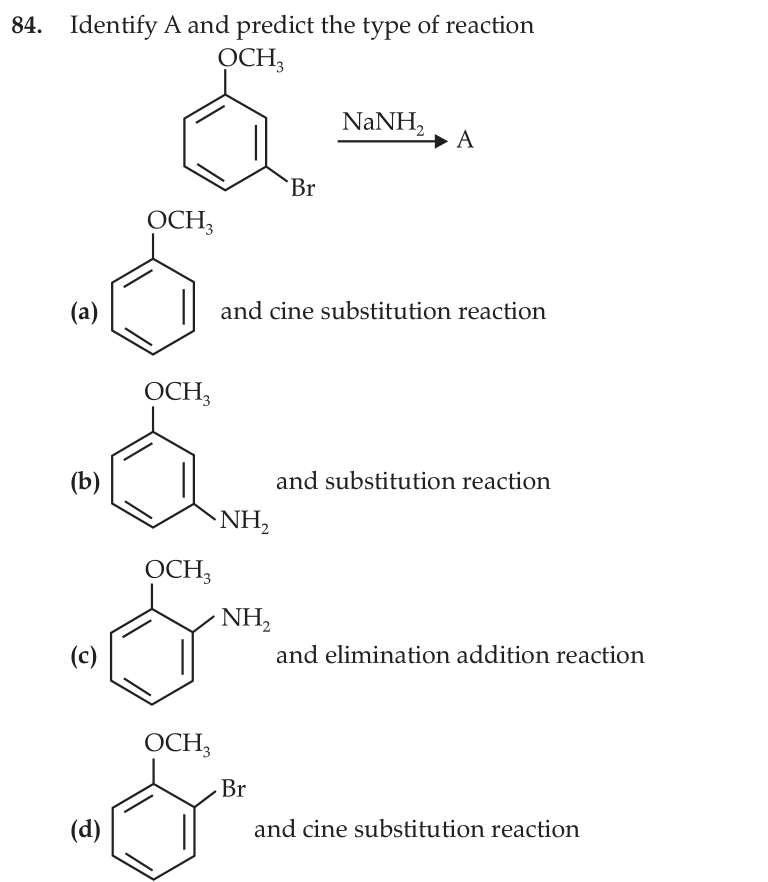
- A.(A)
- B.(B)
- C.(C)
- D.(D)
Show answer
Answer: B. (B)
Q5.An example of a sigma bonded organometallic compound is
- A.cobaltocene.
- B.ruthenocene.
- C.grignard's reagent.
- D.ferrocene.
Show answer
Answer: C. grignard's reagent.
Q6.The reason for greater range of oxidation states in actinoids is attributed to
- A.4f and 5d levels being close in energies.
- B.the radioactive nature of actinoids.
- C.actinoid contraction.
- D.5f, 6d and 7s levels having comparable energies.
Show answer
Answer: D. 5f, 6d and 7s levels having comparable energies.
Q7.The element Z = 114 has been discovered recently. It will belong to which of the following family group and electronic configuration ?
- A.Nitrogen family, [Rn] 5f ¹⁴ 6d¹⁰ 7s² 7p⁶
- B.Halogen family, [Rn] 5f ¹⁴ 6d¹⁰ 7s² 7p⁵
- C.Carbon family, [Rn] 5f ¹⁴ 6d¹⁰ 7s² 7p²
- D.Oxygen family, [Rn] 5f ¹⁴ 6d¹⁰ 7s²7p⁴
Show answer
Answer: C. Carbon family, [Rn] 5f ¹⁴ 6d¹⁰ 7s² 7p²
Q8.A first order reaction has a specific reaction rate of 10⁻² s⁻¹. How much time will it take for 20 g of the reactant to reduce to 5 g ?
- A.693.0 second
- B.238.6 second
- C.138.6 second
- D.346.5 second
Show answer
Answer: C. 138.6 second
Q9.Ionic mobility of which of the following alkali metal ions is lowest when aqueous solution of their salts are put under an electric field ?
- A.Li
- B.Na
- C.K
- D.Rb
Show answer
Answer: A. Li
Q10.In the electrochemical cell Zn|ZnSO₄ (0.01M)| |CuSO₄ (1.0 M)| Cu, the emf of this Daniel cell is E₁. When the concentration of ZnSO₄ is changed to 1.0 M and that of CuSO₄ changed to 0.01 M, the emf changes to E₂. From the following, which one is the relationship between E₁ and E₂ ? (Given, RT F = 0.059)
- A.E₂ = 0 ≠ E₁
- B.E₁ = E₂
- C.E₁ < E₂
- D.E₁ > E₂
Show answer
Answer: D. E₁ > E₂
Q11.Which one of the following nitro-compounds does not react with nitrous acid ?
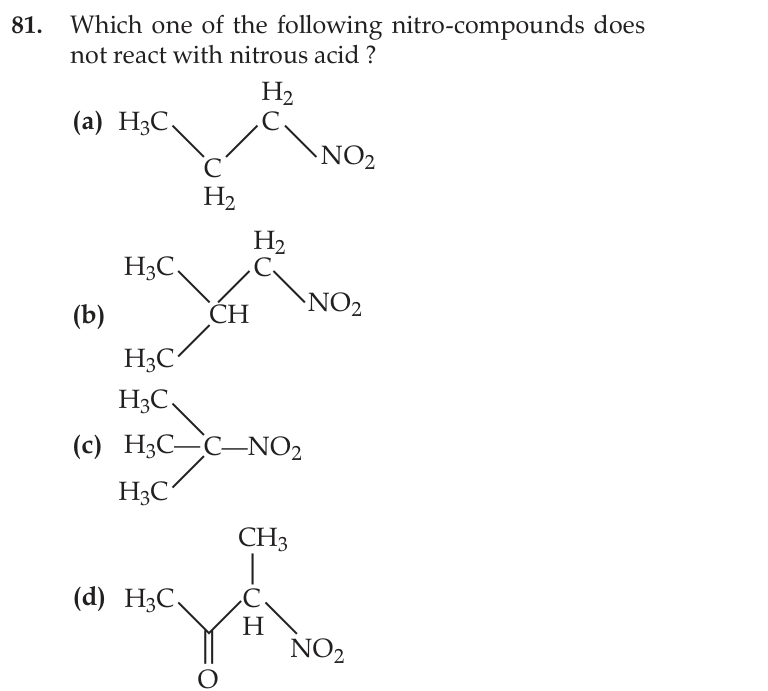
- A.(A)
- B.(B)
- C.(C)
- D.(D)
Show answer
Answer: C. (C)
Q12.The central dogma of molecular genetics states that the genetic information flows from
- A.amino acids → proteins → DNA
- B.DNA → carbohydrates → proteins
- C.DNA → RNA → proteins
- D.DNA → RNA → carbohydrates
Show answer
Answer: C. DNA → RNA → proteins
Q13.The correct corresponding order of names of four aldoses with configuration given below CHO CH OH 2 OH OH H H CHO CH OH 2 OH H HO H CHO CH OH 2 H H HO HO CHO CH OH 2 H OH H HO respectively, is
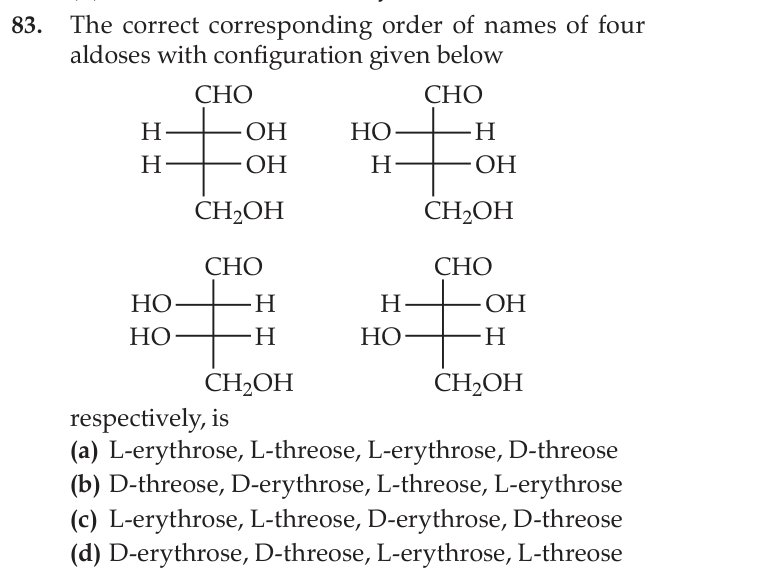
- A.(A)
- B.(B)
- C.(C)
- D.(D)
Show answer
Answer: D. (D)
Q14.In the given reaction the product P is
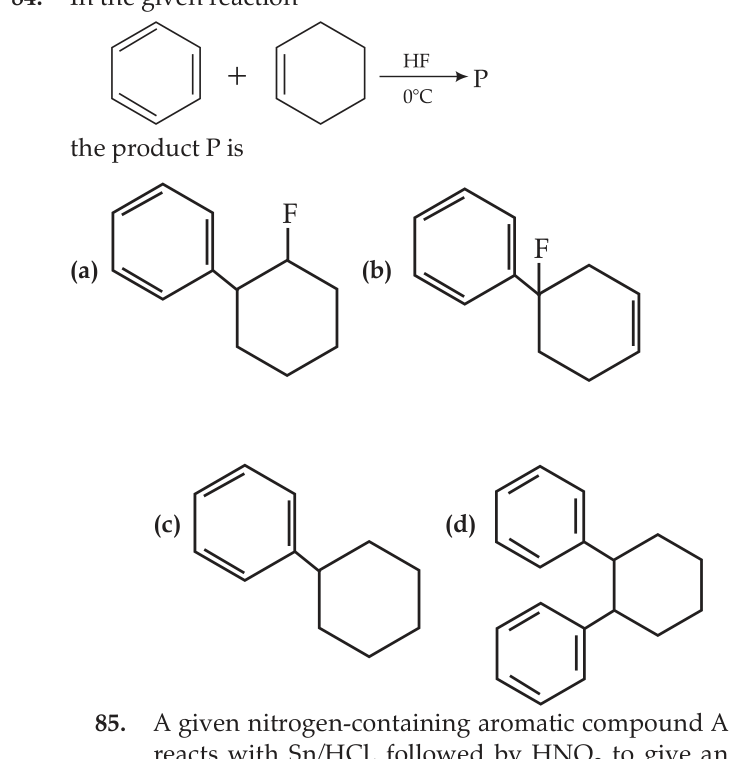
- A.(A)
- B.(B)
- C.(C)
- D.(D)
Show answer
Answer: C. (C)
Q15.A given nitrogen-containing aromatic compound A reacts with Sn/HCl, followed by HNO₂ to give an unstable compound B. B, on treatment with phenol, forms a beautiful coloured compound C with the molecular formula C₁₂H₁₀N₂O. The structure of compound A is
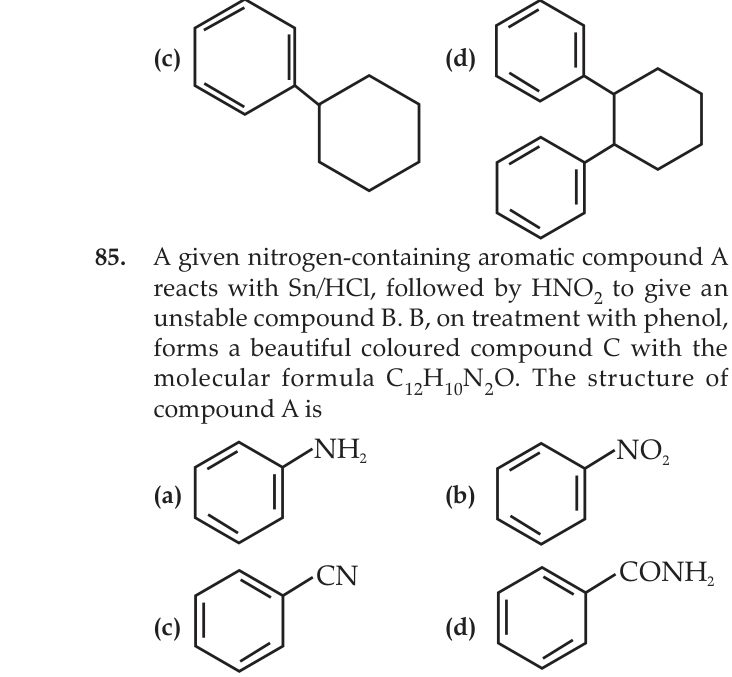
- A.(A)
- B.(B)
- C.(C)
- D.(D)
Show answer
Answer: B. (B)
Q16.Consider the reaction CH₃CH₂CH₂Br + NaCN → CH₃CH₂CH₂CN + NaBr This reaction will be the faster in
- A.ethanol
- B.methanol
- C.N, N′-dimethylformamide (DMF)
- D.water
Show answer
Answer: C. N, N′-dimethylformamide (DMF)
Q17.The correct structure of the product A formed in the reaction Pd/ arbon, ethanol C is
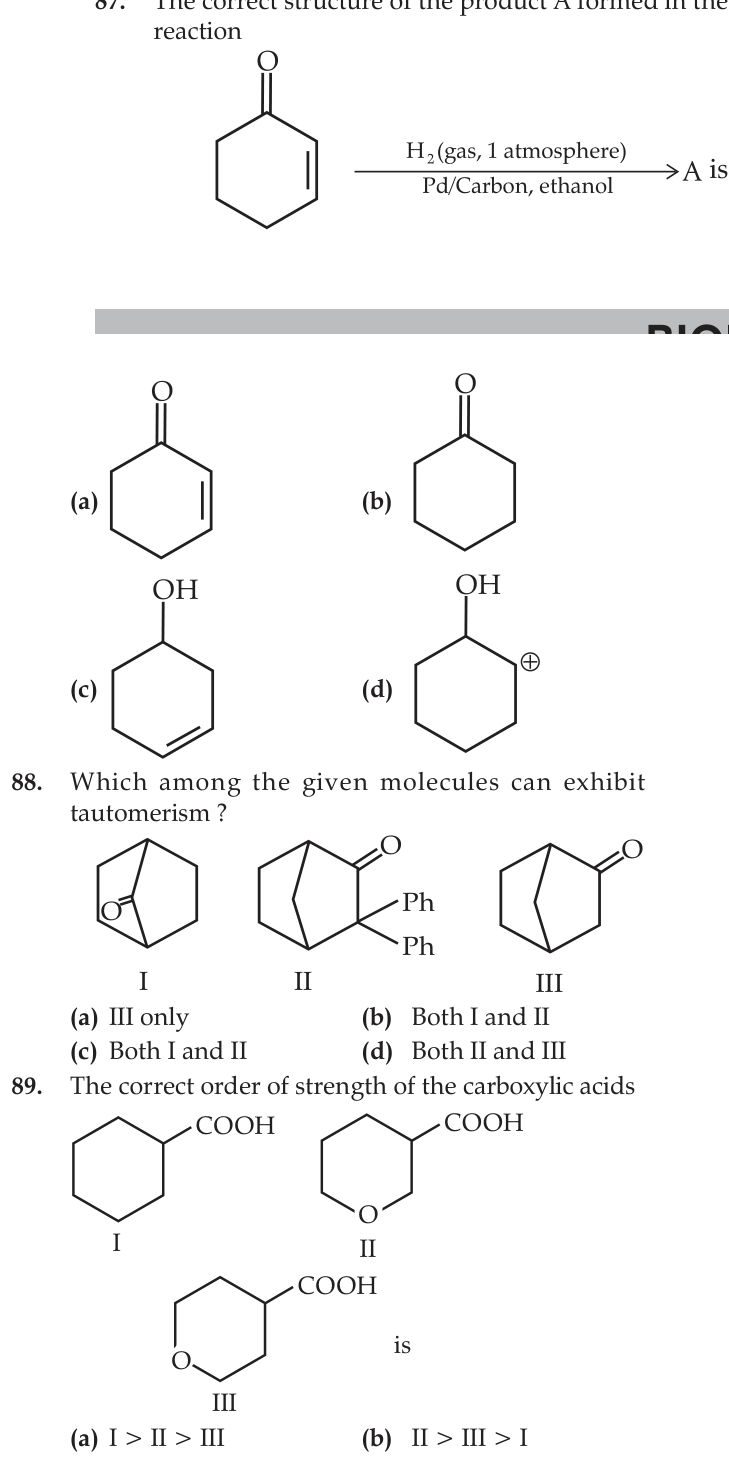
- A.(A)
- B.(B)
- C.(C)
- D.(D)
Show answer
Answer: B. (B)
Q18.Which among the given molecules can exhibit tautomerism ? O O O Ph Ph I II III
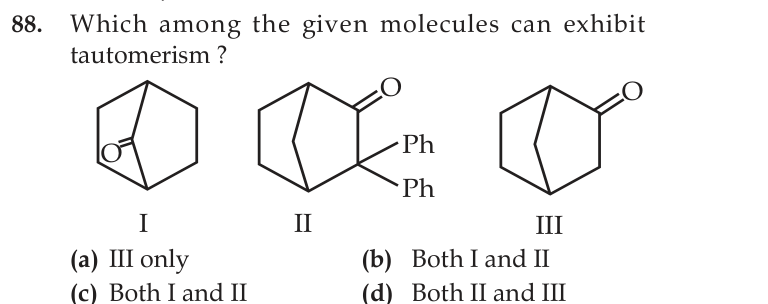
- A.(A)
- B.(B)
- C.(C)
- D.(D)
Show answer
Answer: A. (A)
Q19.The correct order of strength of the carboxylic acids COOH I II COOH O III COOH is O
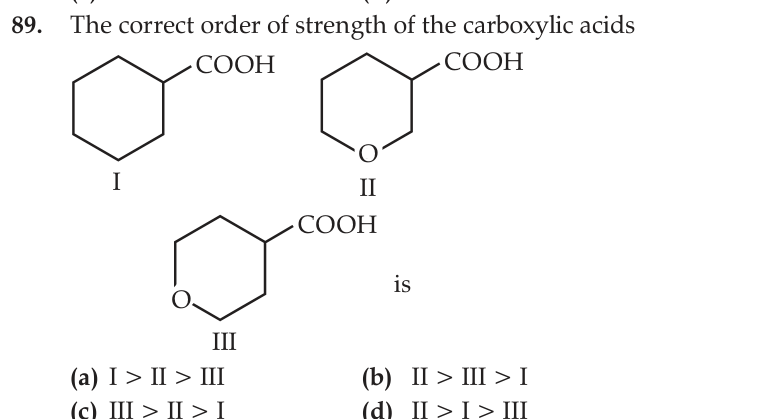
- A.(A)
- B.(B)
- C.(C)
- D.(D)
Show answer
Answer: B. (B)
Q20.The compound that will react most readily with gaseous bromine has the formula
- A.C₃H₆
- B.C₂H₂
- C.C₄H₁₀
- D.C₂H₄
Show answer
Answer: A. C₃H₆
Q21.The correct geometry and hybridisation for XeF₄ are
- A.octahedral, sp³d²
- B.trigonal bipyramidal, sp³d
- C.planar triangle, sp³d³
- D.square planar, sp³d²
Show answer
Answer: D. square planar, sp³d²
Q22.Among the following, which one is a wrong statement ?
- A.PH₅ and BiCl₅ do not exist.
- B.pπ-dπ bonds are present in SO₂.
- C.SeF₄ and CH₄ have same shape.
- D.I₃ + has bent geometry.
Show answer
Answer: C. SeF₄ and CH₄ have same shape.
Q23.The correct increasing order of trans-effect of the following species is
- A.NH₃ > CN⁻ > Br⁻ > C H 6 5 −
- B.CN⁻ > C H 6 5 − > Br⁻ > NH₃
- C.Br⁻ > CN⁻ > NH₃ > C H 6 5 −
- D.CN⁻ > Br⁻ > C H 6 5 − > NH₃
Show answer
Answer: B. CN⁻ > C H 6 5 − > Br⁻ > NH₃
Q24.Which one of the following statements related to lanthanoids is incorrect ?
- A.Europium shows + 2 oxidation state.
- B.The basicity decreases as the ionic radius decreases from Pr to Lu.
- C.All the lanthanoids are much more reactive than aluminium.
- D.Ce (+4) solution are widely used as oxidising agent in volumetric analysis.
Show answer
Answer: C. All the lanthanoids are much more reactive than aluminium.
Q25.Jahn-Teller effect is not observed in high spin complexes of
- A.d⁷
- B.d⁸
- C.d⁴
- D.d⁹
Show answer
Answer: B. d⁸
Q26.Which of the following can be used as the halide component for Friedel-Crafts reaction ?
- A.Chlorobenzene
- B.Bromobenzene
- C.Chloroethene
- D.Isopropyl chloride
Show answer
Answer: D. Isopropyl chloride
Q27.In which of the following molecules, all atoms are coplanar ?
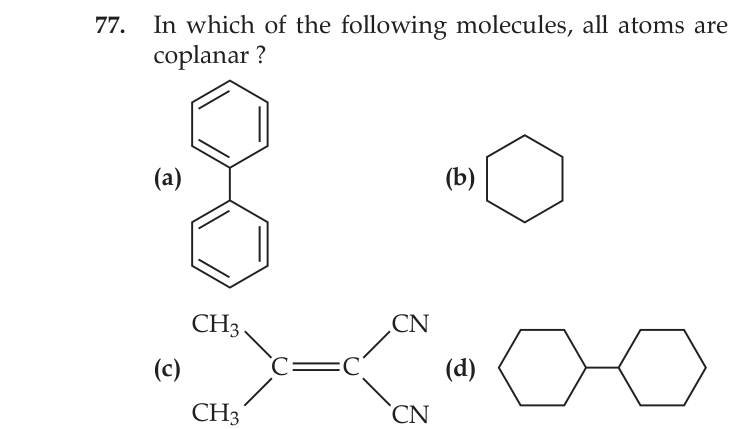
- A.(A)
- B.(B)
- C.(C)
- D.(D)
Show answer
Answer: A. (A)
Q28.Which one of the following structures represents nylon 6, 6 polymer ?
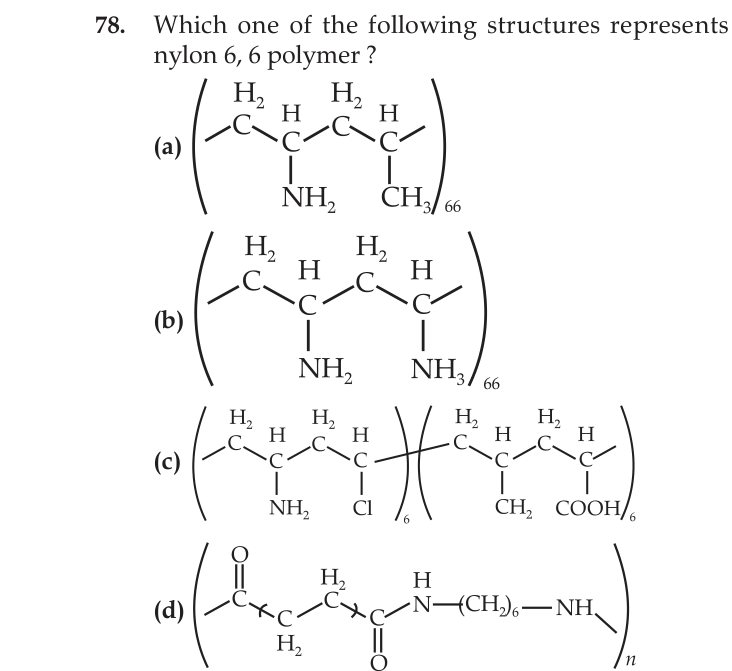
- A.(A)
- B.(B)
- C.(C)
- D.(D)
Show answer
Answer: D. (D)
Q29.In pyrrole the electron density is maximum on
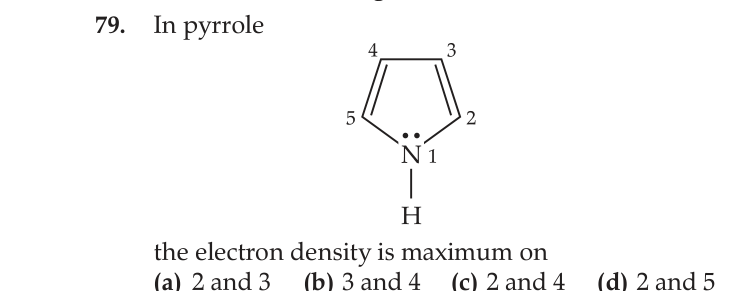
- A.(A)
- B.(B)
- C.(C)
- D.(D)
Show answer
Answer: D. (D)
Q30.Which of the following compounds shall not produce propene by reaction with HBr followed by elimination or direct only elimination reaction ?
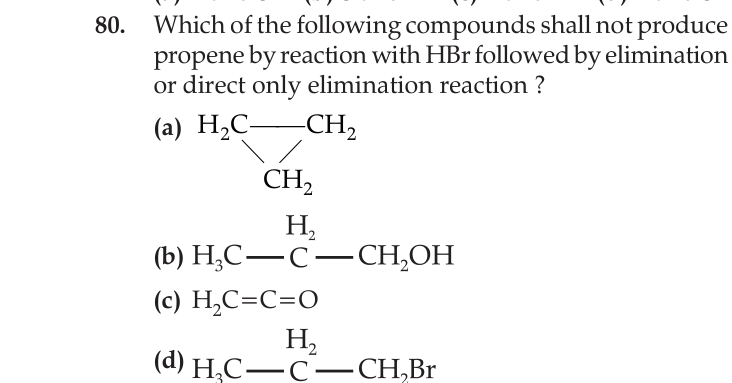
- A.(A)
- B.(B)
- C.(C)
- D.(D)
Show answer
Answer: C. (C)
Keep going
Frequently Asked Questions
How many NEET Chemistry previous year questions are available?
740 Chemistry questions from past NEET papers are available on AajExam, split into 74 practice sets. New questions are added as fresh papers are released.
Are the answers and explanations free?
Yes. Every question on this page shows its correct answer and explanation free of charge, and you do not need an account to read them. A free account only adds attempt tracking and performance analytics.
Do NEET repeat questions from previous years?
Exact repeats do occur, but the more reliable pattern is conceptual: the same Chemistry sub-topics reappear cycle after cycle with reworded questions. That is why working through past questions raises your score more reliably than reading theory alone.
How should I use these questions in my NEET preparation?
Attempt a set of ten cold, review every wrong and guessed question with its explanation, then drill the weak sub-topic on its topic page before moving on. Revisit the same set after a few days — your second-attempt accuracy is the honest measure of whether the concept stuck.
NEET Chemistry practice sets
Each set is a timed 10-question drill drawn from the same question bank.
- NEET - Chemistry PYQ Quiz 47
- NEET - Chemistry PYQ Quiz 56
- NEET - Chemistry PYQ Quiz 55
- NEET - Chemistry PYQ Quiz 54
- NEET - Chemistry PYQ Quiz 53
- NEET - Chemistry PYQ Quiz 52
- NEET - Chemistry PYQ Quiz 51
- NEET - Chemistry PYQ Quiz 50
- NEET - Chemistry PYQ Quiz 49
- NEET - Chemistry PYQ Quiz 48
- NEET - Chemistry PYQ Quiz 57
- NEET - Chemistry PYQ Quiz 46
- NEET - Chemistry PYQ Quiz 45
- NEET - Chemistry PYQ Quiz 44
- NEET - Chemistry PYQ Quiz 43
- NEET - Chemistry PYQ Quiz 42
- NEET - Chemistry PYQ Quiz 41
- NEET - Chemistry PYQ Quiz 40
- NEET - Chemistry PYQ Quiz 39
- NEET - Chemistry PYQ Quiz 66
- NEET - Chemistry PYQ Quiz 74
- NEET - Chemistry PYQ Quiz 73
- NEET - Chemistry PYQ Quiz 72
- NEET - Chemistry PYQ Quiz 71
- NEET - Chemistry PYQ Quiz 70
- NEET - Chemistry PYQ Quiz 69
- NEET - Chemistry PYQ Quiz 68
- NEET - Chemistry PYQ Quiz 67
- NEET - Chemistry PYQ Quiz 38
- NEET - Chemistry PYQ Quiz 65
- NEET - Chemistry PYQ Quiz 64
- NEET - Chemistry PYQ Quiz 63
- NEET - Chemistry PYQ Quiz 62
- NEET - Chemistry PYQ Quiz 61
- NEET - Chemistry PYQ Quiz 60
- NEET - Chemistry PYQ Quiz 59
- NEET - Chemistry PYQ Quiz 58
- NEET - Chemistry PYQ Quiz 10
- NEET - Chemistry PYQ Quiz 19
- NEET - Chemistry PYQ Quiz 18