NEET Botany — Previous Year Questions
190 Botany questions asked in past NEET papers, split into 19 timed practice sets — every question with its answer and explanation.
About NEET Botany previous year questions
Botany PYQs asked in NEET
A sample of 30 questions from the full bank of 190. Try each one before opening the solution — the remaining questions are in the timed practice sets below.
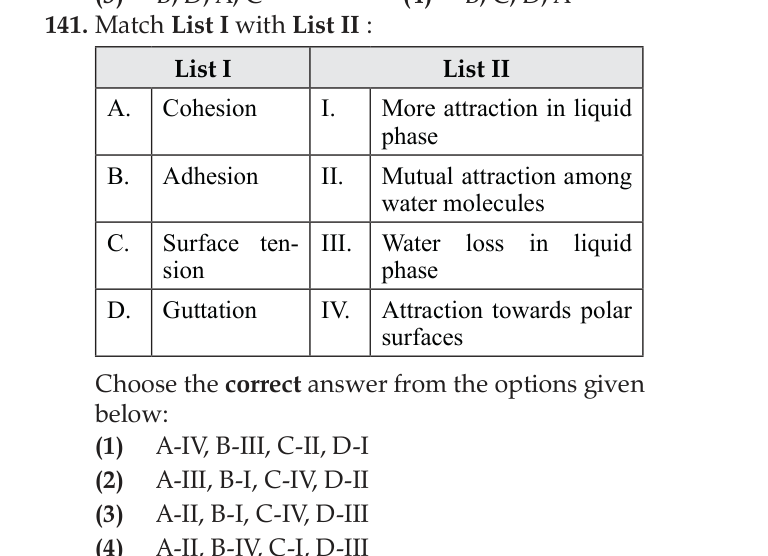
Q1.Match List I with List II : List I List II A. Cohesion I. More attraction in liquid phase B. Adhesion II. Mutual attraction among water molecules C. Surface ten- sion III. Water loss in liquid phase D. Guttation IV. Attraction towards polar surfaces Choose the correct answer from the options given below:
- A.(A)
- B.(B)
- C.(C)
- D.(D)
Show answer
Answer: D. (D)
Q2.Which one of the following statements is NOT correct?
- A.Algal blooms caused by excess of organic matter in water improve water quality and promote fisheries.
- B.Water hyacinth grows abundantly in eu- trophic water bodies and leads to an imbal- ance in the ecosystem dynamics of the water body.
- C.The amount of some toxic substances of industrial waste water increases in the organisms at successive trophic levels.
- D.The micro-organisms involved in biodeg- radation of organic matter in a sewage pol- luted water body consume a lot of oxygen causing the death of aquatic organisms.
Show answer
Answer: A. Algal blooms caused by excess of organic matter in water improve water quality and promote fisheries.
Q3.How many different proteins does the ribosome consist of?

- A.(A)
- B.(B)
- C.(C)
- D.(D)
Show answer
Answer: D. (D)
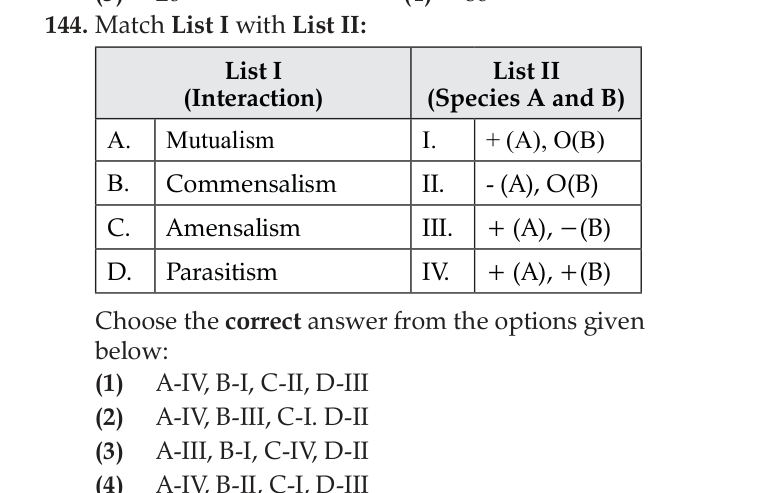
Q4.Match List I with List II: List I (Interaction) List II (Species A and B) A. Mutualism I. + (A), O(B) B. Commensalism II. - (A), O(B) C. Amensalism III. + (A), −(B) D. Parasitism IV. + (A), +(B) Choose the correct answer from the options given below:
- A.(A)
- B.(B)
- C.(C)
- D.(D)
Show answer
Answer: A. (A)
Q5.Given below are two statements : One is labelled as Assertion A and the other is labeled as Reason R: Assertion A: A flower is defined as modified shoot wherein the shoot apical meristem changes to floral meristem. Reason R: Internode of the shoot gets condensed to produce different floral appendages laterally at successive nodes instead of leaves. In the light of the above statements, choose the correct answer from the options given below:
- A.Both A and R are true but R is NOT the correct explanation of A.
- B.A is true but R is false.
- C.A is false but R is true.
- D.Both A and R are true and R is the correct explanation of A.
Show answer
Answer: D. Both A and R are true and R is the correct explanation of A.
Q6.Identify the correct statements: A. Lenticels are the lens-shaped openings permitting the exchange of gases. B. Bark formed early in the season is called hard bark. C. Bark is a technical term that refers to all tissues exterior to vascular cambium. D. Bark refers to periderm and secondary phloem. E. Phellogen is single-layered in thickness. Choose the correct answer from the options given below:
- A.A and D only
- B.A, B and D only
- C.B and C only
- D.B, C and E only
Show answer
Answer: A. A and D only
Q7.Given below are two statements : Statement I: Gause’s ‘Competitive Exclusion Prin- ciple states that two closely related species com- peting for the same resources cannot co-exist in- definitely and competitively inferior one will be eliminated eventually. Statement II: In general, carnivores are more adversely affected by competition than herbivores. In the light of the above statements, choose the correct answer from the options given below:
- A.Both Statement I and Statement II are false.
- B.Statement I is correct but Statement II is false.
- C.Statement I is incorrect but Statement II is true.
- D.Both Statement I and Statement II are true.
Show answer
Answer: B. Statement I is correct but Statement II is false.
Q8.Which of the following statements are correct about Klinefelter’s Syndrome? A. This disorder was first described by Langdon Down (1866). B. Such an individual has overall masculine development. However, the feminine development is also expressed. C. The affected individual is short statured. D. Physical, psychomotor and mental develop- ment is retarded. E. Such individuals are sterile. Choose the correct answer from the options given below:
- A.C and D only
- B.B and E only
- C.A and E only
- D.A and B only
Show answer
Answer: B. B and E only
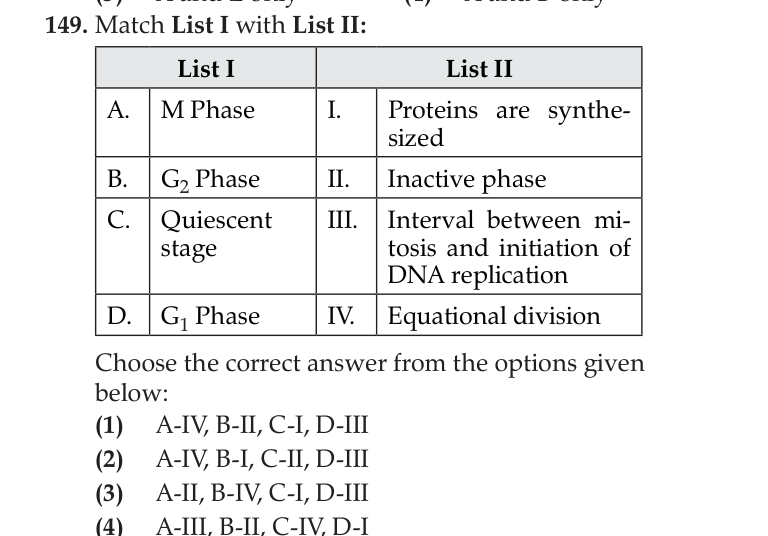
Q9.Match List I with List II: List I List II A. M Phase I. Proteins are synthe- sized B. G₂ Phase II. Inactive phase C. Quiescent stage III. Interval between mi- tosis and initiation of DNA replication D. G₁ Phase IV. Equational division Choose the correct answer from the options given below:
- A.(A)
- B.(B)
- C.(C)
- D.(D)
Show answer
Answer: B. (B)
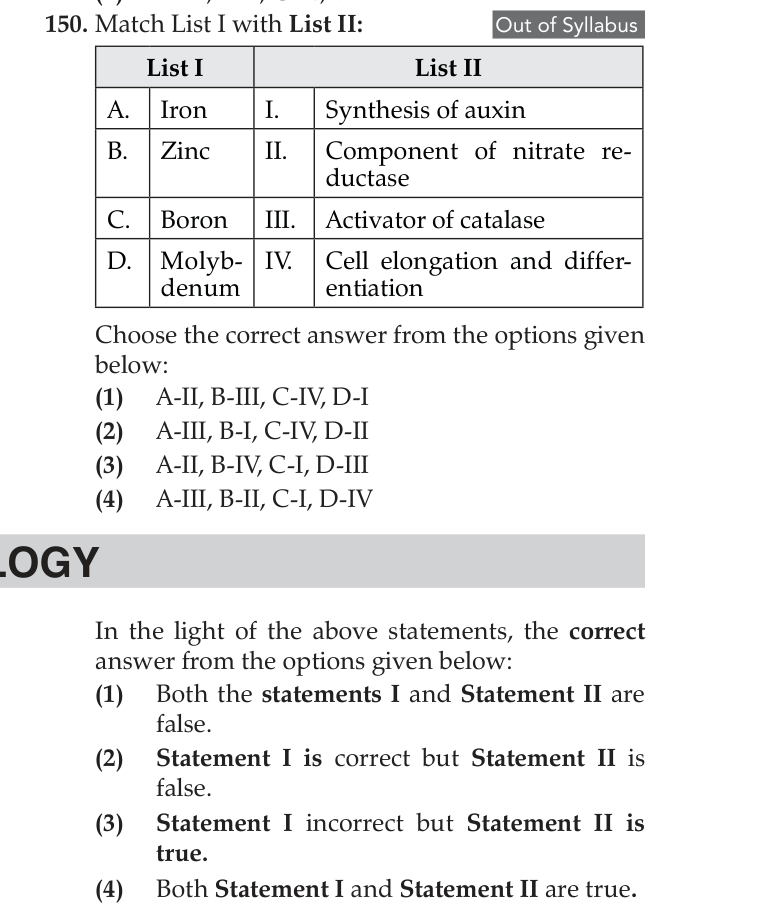
Q10.Match List I with List II: List I List II A. Iron I. Synthesis of auxin B. Zinc II. Component of nitrate re- ductase C. Boron III. Activator of catalase D. Molyb- denum IV. Cell elongation and differ- entiation Choose the correct answer from the options given below:
- A.(A)
- B.(B)
- C.(C)
- D.(D)
Show answer
Answer: B. (B)
Q11.When the centromere is situated in the middle of two equal arms of chromosomes, the chromosome is referred as
- A.acrocentric.
- B.metacentric.
- C.telocentric.
- D.sub-metacentric.
Show answer
Answer: B. metacentric.
Q12.Genera like Selaginella and Salvinia produce two kinds of spores. Such plants are known as
- A.Heterosporous
- B.Homosorus
- C.Heterosorus
- D.Homosporous
Show answer
Answer: A. Heterosporous
Q13.Match List-I with List-II List-I List-II
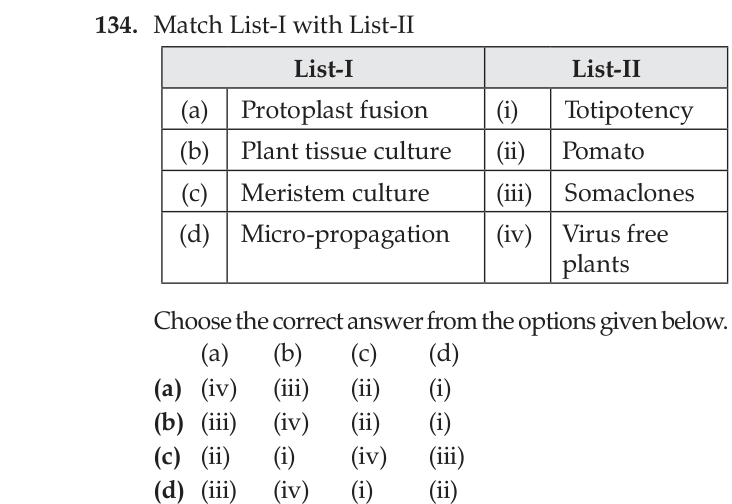
- A.(A)
- B.(B)
- C.(C)
- D.(D)
Show answer
Answer: C. (C)
Q14.Which of the following is not an application of PCR (Polymerase Chain Reaction) ?
- A.Detection of gene mutation
- B.Molecular diagnosis
- C.Gene amplification
- D.Purification of isolated protein
Show answer
Answer: D. Purification of isolated protein
Q15.Identify the correct statement.
- A.Split gene arrangement is characteristic of prokaryotes.
- B.In capping, methyl guanosine triphosphate is added to the 3' end of hnRNA.
- C.RNA polymerase binds with Rho factor to terminate the process of transcription in bacteria.
- D.The coding strand in a transcription unit is copied to an mRNA.
Show answer
Answer: C. RNA polymerase binds with Rho factor to terminate the process of transcription in bacteria.
Q16.Now a days it is possible to detect the mutated gene causing cancer by allowing radioactive probe to hybridise its complimentary DNA in a clone of cells, followed by its detection using autoradiography because
- A.mutated gene does not appear on photographic film as the probe has complementarity with it.
- B.mutated gene partially appears on a photographic film.
- C.mutated gene completely and clearly appears on a photographic film.
- D.mutated gene does not appear on a photographic film as the probe has no complementarity with it.
Show answer
Answer: D. mutated gene does not appear on a photographic film as the probe has no complementarity with it.
Q17.What is the role of RNA polymerase III in the process of transcription in eukaryotes ?
- A.Transcribes only snRNAs
- B.Transcribes rRNAs (28S, 18S and 5.8S)
- C.Transcribes tRNA, 5s rRNA and snRNA
- D.Transcribes precursor of mRNA
Show answer
Answer: C. Transcribes tRNA, 5s rRNA and snRNA
Q18.Select the correct pair.
- A.Loose parenchyma – Spongy cell rupturing the parenchyma epidermis and forming a lens shaped opening in bark
- B.Large colorless – Subsidiary cells empty cells in the epidermis of grass leaves
- C.In dicot leaves, – Conjunctive vascular bundles tissue are surrounded by large thick- walled cells
- D.Cells of – Interfascicular medullary rays cambium that form part of cambial ring
Show answer
Answer: D. Cells of – Interfascicular medullary rays cambium that form part of cambial ring
Q19.In the exponential growth equation N_(t) = N₀e^(rt), e represents
- A.The base of geometric logarithms
- B.The base of number logarithms
- C.The base of exponential logarithms
- D.The base of natural logarithms
Show answer
Answer: D. The base of natural logarithms
Q20.Which of the following statements is incorrect ?
- A.Oxidation-reduction reactions produce proton gradient in respiration.
- B.During aerobic respiration, role of oxygen is limited to the terminal stage.
- C.In ETC (Electron Transport Chain), one molecule of NADH + H⁺ gives rise to 2 ATP molecules, and one FADH₂ gives rise to 3 ATP molecules.
- D.ATP is synthesized through complex V.
Show answer
Answer: C. In ETC (Electron Transport Chain), one molecule of NADH + H⁺ gives rise to 2 ATP molecules, and one FADH₂ gives rise to 3 ATP molecules.
Q21.Which of the following is an incorrect statement ?
- A.Nuclear pores act as passages for proteins and RNA molecules in both directions between nucleus and cytoplasm.
- B.Mature sieve tube elements possess a conspicuous nucleus and usual cytoplasmic organelles.
- C.Microbodies are present both in plant and animal cells.
- D.The perinuclear space forms a barrier between the materials present inside the nucleus and that of the cytoplasm.
Show answer
Answer: B. Mature sieve tube elements possess a conspicuous nucleus and usual cytoplasmic organelles.
Q22.Mutations in plant cells can be induced by
- A.zeatin.
- B.kinetin.
- C.infrared rays.
- D.gamma rays.
Show answer
Answer: D. gamma rays.
Q23.The first stable product of CO₂ fixation in Sorghum is
- A.phosphoglyceric acid.
- B.pyruvic acid.
- C.oxaloacetic acid.
- D.succinic acid.
Show answer
Answer: C. oxaloacetic acid.
Q24.Match List-I with List-II. List-I List-II
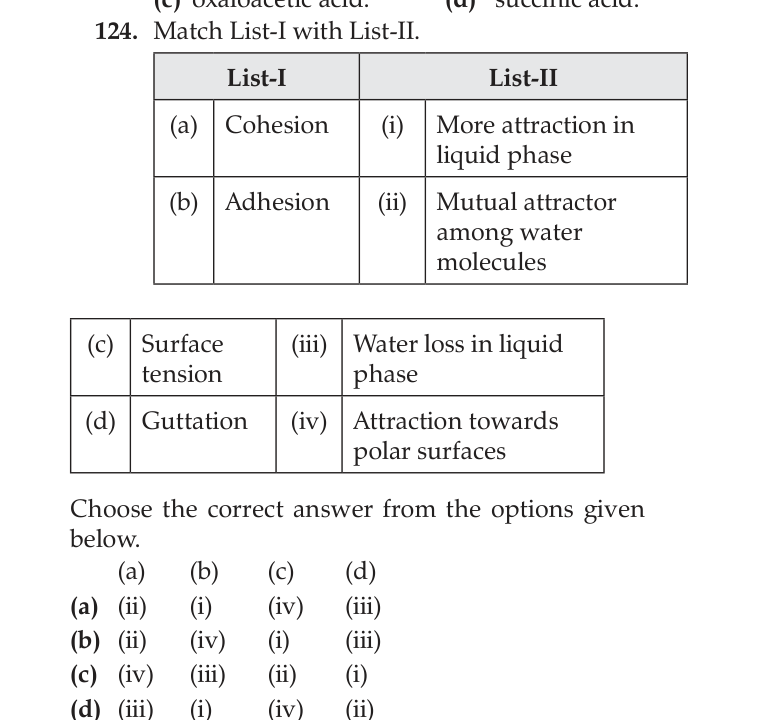
- A.(A)
- B.(B)
- C.(C)
- D.(D)
Show answer
Answer: B. (B)
Q25.Amensalism can be represented as
- A.Species A (+); Species B (0)
- B.Species A (–); Species B (0)
- C.Species A (+); Species B (+)
- D.Species A (–); Species B (–)
Show answer
Answer: B. Species A (–); Species B (0)
Q26.Which of the following stages of meiosis involves division of centromere ?
- A.Telophase II
- B.Metaphase I
- C.Metaphase II
- D.Anaphase II
Show answer
Answer: D. Anaphase II
Q27.When gene targetting involving gene amplification is attempted in an individual's tissue to treat disease, it is known as
- A.safety testing.
- B.biopiracy.
- C.gene therapy.
- D.molecular diagnosis.
Show answer
Answer: C. gene therapy.
Q28.The amount of nutrients, such as carbon, nitrogen, phosphorus and calcium present in the soil at any given time, is referred as
- A.standing crop.
- B.climax.
- C.climax community.
- D.standing state.
Show answer
Answer: D. standing state.
Q29.Which of the following statements is not correct ?
- A.Pyramid of numbers in a grassland ecosystem is upright.
- B.Pyramid of biomass in sea is generally inverted.
- C.Pyramid of biomass in sea is generally upright.
- D.Pyramid of energy is always upright.
Show answer
Answer: C. Pyramid of biomass in sea is generally upright.
Q30.A typical angiosperm embryo sac at maturity is
- A.8-nucleate and 8-celled
- B.8-nucleate and 7-celled
- C.7-nucleate and 8-celled
- D.7-nucleate and 7-celled
Show answer
Answer: B. 8-nucleate and 7-celled
Keep going
Frequently Asked Questions
How many NEET Botany previous year questions are available?
190 Botany questions from past NEET papers are available on AajExam, split into 19 practice sets. New questions are added as fresh papers are released.
Are the answers and explanations free?
Yes. Every question on this page shows its correct answer and explanation free of charge, and you do not need an account to read them. A free account only adds attempt tracking and performance analytics.
Do NEET repeat questions from previous years?
Exact repeats do occur, but the more reliable pattern is conceptual: the same Botany sub-topics reappear cycle after cycle with reworded questions. That is why working through past questions raises your score more reliably than reading theory alone.
How should I use these questions in my NEET preparation?
Attempt a set of ten cold, review every wrong and guessed question with its explanation, then drill the weak sub-topic on its topic page before moving on. Revisit the same set after a few days — your second-attempt accuracy is the honest measure of whether the concept stuck.
NEET Botany practice sets
Each set is a timed 10-question drill drawn from the same question bank.
- NEET - Botany PYQ Quiz 10
- NEET - Botany PYQ Quiz 19
- NEET - Botany PYQ Quiz 18
- NEET - Botany PYQ Quiz 17
- NEET - Botany PYQ Quiz 16
- NEET - Botany PYQ Quiz 15
- NEET - Botany PYQ Quiz 14
- NEET - Botany PYQ Quiz 13
- NEET - Botany PYQ Quiz 12
- NEET - Botany PYQ Quiz 11
- NEET - Botany PYQ Quiz 1
- NEET - Botany PYQ Quiz 9
- NEET - Botany PYQ Quiz 8
- NEET - Botany PYQ Quiz 7
- NEET - Botany PYQ Quiz 6
- NEET - Botany PYQ Quiz 5
- NEET - Botany PYQ Quiz 4
- NEET - Botany PYQ Quiz 3
- NEET - Botany PYQ Quiz 2