NEET Biology — Previous Year Questions
1060 Biology questions asked in past NEET papers, split into 106 timed practice sets — every question with its answer and explanation.
About NEET Biology previous year questions
Biology PYQs asked in NEET
A sample of 30 questions from the full bank of 1060. Try each one before opening the solution — the remaining questions are in the timed practice sets below.
Q1.Which of the following is correctly matched ?
- A.Aerenchyma — Opuntia
- B.Age pyramid — Biome
- C.Parthenium — Threat to hysterophorus biodiversity
- D.Stratification — Population
Show answer
Answer: C. Parthenium — Threat to hysterophorus biodiversity
Q2.Red List contains data or information on
- A.all economically important plants.
- B.plants whose products are in international trade.
- C.threatened species.
- D.marine vertebrates only.
Show answer
Answer: C. threatened species.
Q3.Which of the following sets of diseases is caused by bacteria ?
- A.Cholera and tetanus
- B.Typhoid and smallpox
- C.Tetanus and mumps
- D.Herpes and influenza
Show answer
Answer: A. Cholera and tetanus
Q4.Match column I with column II for housefly classification and select the correct option using the codes given below Column I Column II A. Family 1. Diptera B. Order 2. Arthropoda C. Class 3. Muscidae D. Phylum 4. Insecta Codes A B C D
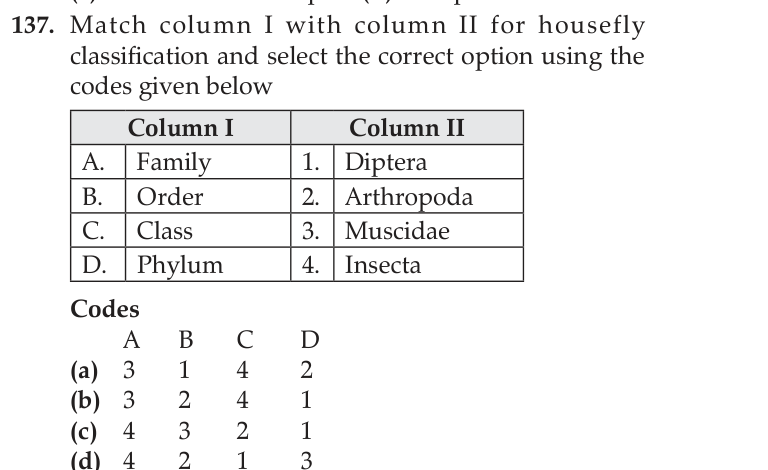
- A.(A)
- B.(B)
- C.(C)
- D.(D)
Show answer
Answer: A. (A)
Q5.Choose the correct statement.
- A.All mammals are viviparous.
- B.All cyclostomes do not possess jaws and paired fins.
- C.All reptiles have a three-chambered heart.
- D.All Pisces have gills covered by an operculum.
Show answer
Answer: B. All cyclostomes do not possess jaws and paired fins.
Q6.Study the four statements (I-IV) given below and select the two correct ones out of them. I. Definition of biological species was given by Ernst Mayr. II. Photoperiod does not affect reproduction in plants. III. Binomial nomenclature system was given by RH Whittaker. IV. In unicellular organisms, reproduction is synonymous with growth. The two correct statements are
- A.II and III
- B.III and IV
- C.I and IV
- D.I and II
Show answer
Answer: C. I and IV
Q7.In male cockroaches, sperms are stored in which part of the reproductive system ?
- A.Seminal vesicles
- B.Mushroom glands
- C.Testes
- D.Vas deferens
Show answer
Answer: A. Seminal vesicles
Q8.Smooth muscles are
- A.involuntary, fusiform, non-striated
- B.voluntary, multinucleate, cylindrical
- C.involuntary, cylindrical, striated
- D.voluntary, spindle-shaped, uninucleate
Show answer
Answer: A. involuntary, fusiform, non-striated
Q9.Oxidative phosphorylation is
- A.formation of ATP by transfer of phosphate group from a substrate to ADP.
- B.oxidation of phosphate group in ATP.
- C.addition of phosphate group to ATP.
- D.formation of ATP by energy released from electron removed during substrate oxidation.
Show answer
Answer: D. formation of ATP by energy released from electron removed during substrate oxidation.
Q10.Which of the following is the least likely to be involved in stabilising the three-dimensional folding of most proteins ?
- A.Hydrogen bonds
- B.Electrostatic interaction
- C.Hydrophobic interaction
- D.Ester bonds
Show answer
Answer: A. Hydrogen bonds
Q11.The following graph depicts changes in two populations (A and B) of herbivores in grassy populations (A and B) of herbivores in grassy field A possible reason for these changes is that Number of organism Time A B
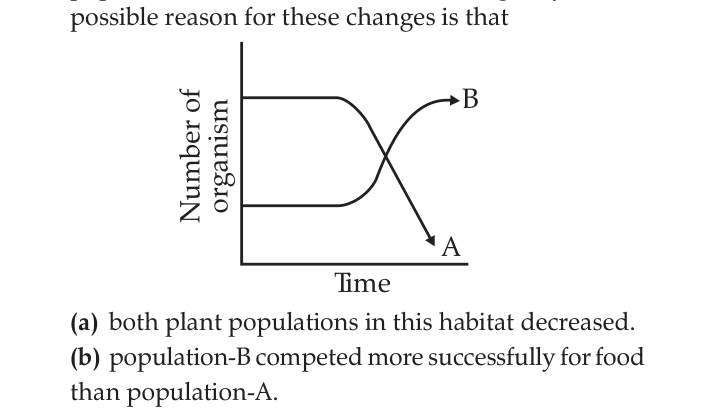
- A.both plant populations in this habitat decreased.
- B.population-B competed more success fully for food than population-A.
- C.population-A produced more offspring than population-B.
- D.population-A consumed the members of population-B.
Show answer
Answer: B. population-B competed more success fully for food than population-A.
Q12.Cryopreservation of gametes of threatened species in viable and fertile condition can be referred to as
- A.in situ conservation of biodiversity.
- B.advanced ex situ conservation of biodiversity.
- C.in situ conservation by sacred groves.
- D.in situ cryo-preservation of biodiversity.
Show answer
Answer: B. advanced ex situ conservation of biodiversity.
Q13.Rachel Carson's famous book 'Silent Spring' is related to
- A.pesticide pollution
- B.noise pollution
- C.population explosion
- D.ecosystem management
Show answer
Answer: A. pesticide pollution
Q14.Which of the following is not one of the prime health risks associated with greater UV radiation through the atmosphere due to depletion of stratospheric ozone ?
- A.Increased skin cancer.
- B.Reduced immune system.
- C.Damage to eyes.
- D.Increased liver cancer.
Show answer
Answer: D. Increased liver cancer.
Q15.Read the different components from I to IV in the list given below and tell the correct order of the components with reference to their arrangement from outer side to inner side in a woody dicot stem I. Secondary cortex II. Wood III. Secondary phloem IV. Phellem The correct order is
- A.III, IV, II, I
- B.I, II, IV, III
- C.IV, I, III, II
- D.IV, III, I, II
Show answer
Answer: C. IV, I, III, II
Q16.Chromatophores take part in
- A.photosynthesis.
- B.growth.
- C.movement.
- D.respiration.
Show answer
Answer: A. photosynthesis.
Q17.Which of the following joints would allow no movement ?
- A.Fibrous joint
- B.Cartilaginous joint
- C.Synovial joint
- D.Ball and socket joint
Show answer
Answer: A. Fibrous joint
Q18.The wheat grain has an embryo with one large, shield- shaped cotyledon known as
- A.epiblast.
- B.coleorrhiza.
- C.scutellum.
- D.coleoptile.
Show answer
Answer: C. scutellum.
Q19.A gene showing co-dominance has
- A.one allele dominant on the other.
- B.alleles tightly linked on the same chro-mosome.
- C.alleles that are recessive to each other.
- D.both alleles independently expressed in the heterozygote.
Show answer
Answer: D. both alleles independently expressed in the heterozygote.
Q20.Which of the following structure is not found in a prokaryotic cell ?
- A.Nuclear envelope
- B.Ribosome
- C.Mesosome
- D.Plasma membrane
Show answer
Answer: A. Nuclear envelope
Q21.A man with blood group ‘A’ marries a woman with blood group ‘B’. What are all the possible blood groups of their off-springs ?
- A.A and B
- B.A, B and AB
- C.A, B, AB and O
- D.Only O
Show answer
Answer: C. A, B, AB and O
Q22.Gene regulation governing lactose operon of E. coli that involves the lac I gene products is
- A.positive and inducible because it can be induced by lactose.
- B.negative and inducible because repre ssor protein prevents transcription.
- C.negative and repressible because repre ssor protein prevents transcription.
- D.feedback inhibition because excess of b-galactosidase can switch off transcription.
Show answer
Answer: B. negative and inducible because repre ssor protein prevents transcription.
Q23.In sea urchin DNA, which is double stranded, 17% of the bases were shown to be cytosine. The percentages of the other three bases expected to be present in this DNA are
- A.G/34%, A/24.5%, T/24.5%
- B.G/17%, A/16.5%, T/32.5%
- C.G/17%, A/33%, T/33%
- D.G/8.5%, A/50%, T/24.5%
Show answer
Answer: C. G/17%, A/33%, T/33%
Q24.Which of the following had the smallest brain capacity?
- A.Homo erectus
- B.Homo sapiens
- C.Homo neanderthalensis
- D.Homo habilis
Show answer
Answer: D. Homo habilis
Q25.A population will not exist in Hardy-Weinberg equilibrium if
- A.individuals mate selectively
- B.there are no mutations
- C.there is no migration.
- D.the population is large.
Show answer
Answer: A. individuals mate selectively
Q26.Match each disease with its correct type of vaccine. Column I Column II A. Tuberculosis 1. Harmless virus B. Whooping cough 2. Inactivated toxin C. Diphtheria 3. Killed bacteria D. Polio 4. Harmless bacteria Code A B C D
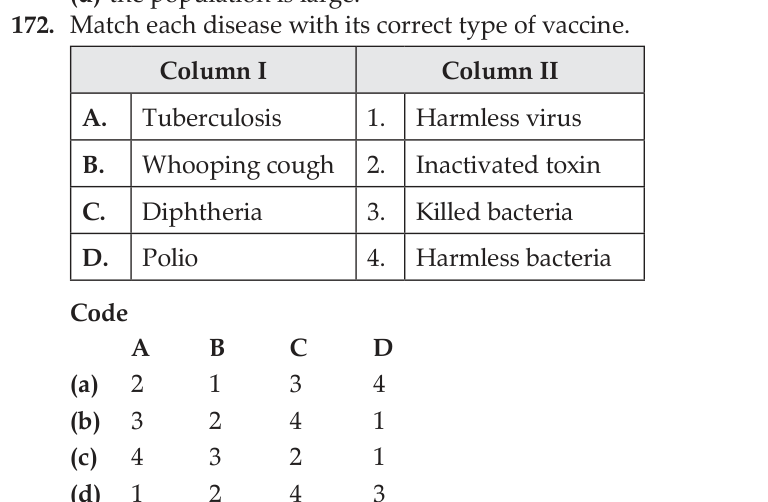
- A.(A)
- B.(B)
- C.(C)
- D.(D)
Show answer
Answer: C. (C)
Q27.HIV that causes AIDS, first starts destroying
- A.B-lymphocytes
- B.leucocytes
- C.helper T-lymphocytes
- D.thrombocytes
Show answer
Answer: C. helper T-lymphocytes
Q28.The active forth of Entamoeba histolytica feed upon
- A.erythrocytes, mucosa and submucosa of colon.
- B.mucosa and submucosa of colon only
- C.food in intestine.
- D.blood only.
Show answer
Answer: A. erythrocytes, mucosa and submucosa of colon.
Q29.High value of BOD (Biochemical Oxygen Demand) indicates that
- A.water is pure.
- B.water is highly polluted.
- C.water is less polluted.
- D.consumption of organic matter in the water is higher by the microbes.
Show answer
Answer: B. water is highly polluted.
Q30.Most of the animals are tree dwellers in a
- A.coniferous forest.
- B.thorn woodland.
- C.temperate deciduous forest
- D.tropical rain forest.
Show answer
Answer: D. tropical rain forest.
Keep going
Frequently Asked Questions
How many NEET Biology previous year questions are available?
1060 Biology questions from past NEET papers are available on AajExam, split into 106 practice sets. New questions are added as fresh papers are released.
Are the answers and explanations free?
Yes. Every question on this page shows its correct answer and explanation free of charge, and you do not need an account to read them. A free account only adds attempt tracking and performance analytics.
Do NEET repeat questions from previous years?
Exact repeats do occur, but the more reliable pattern is conceptual: the same Biology sub-topics reappear cycle after cycle with reworded questions. That is why working through past questions raises your score more reliably than reading theory alone.
How should I use these questions in my NEET preparation?
Attempt a set of ten cold, review every wrong and guessed question with its explanation, then drill the weak sub-topic on its topic page before moving on. Revisit the same set after a few days — your second-attempt accuracy is the honest measure of whether the concept stuck.
NEET Biology practice sets
Each set is a timed 10-question drill drawn from the same question bank.
- NEET - Biology PYQ Quiz 67
- NEET - Biology PYQ Quiz 80
- NEET - Biology PYQ Quiz 79
- NEET - Biology PYQ Quiz 78
- NEET - Biology PYQ Quiz 77
- NEET - Biology PYQ Quiz 76
- NEET - Biology PYQ Quiz 75
- NEET - Biology PYQ Quiz 74
- NEET - Biology PYQ Quiz 73
- NEET - Biology PYQ Quiz 72
- NEET - Biology PYQ Quiz 71
- NEET - Biology PYQ Quiz 70
- NEET - Biology PYQ Quiz 69
- NEET - Biology PYQ Quiz 68
- NEET - Biology PYQ Quiz 81
- NEET - Biology PYQ Quiz 66
- NEET - Biology PYQ Quiz 65
- NEET - Biology PYQ Quiz 64
- NEET - Biology PYQ Quiz 63
- NEET - Biology PYQ Quiz 62
- NEET - Biology PYQ Quiz 61
- NEET - Biology PYQ Quiz 60
- NEET - Biology PYQ Quiz 59
- NEET - Biology PYQ Quiz 58
- NEET - Biology PYQ Quiz 57
- NEET - Biology PYQ Quiz 56
- NEET - Biology PYQ Quiz 55
- NEET - Biology PYQ Quiz 94
- NEET - Biology PYQ Quiz 106
- NEET - Biology PYQ Quiz 105
- NEET - Biology PYQ Quiz 104
- NEET - Biology PYQ Quiz 103
- NEET - Biology PYQ Quiz 102
- NEET - Biology PYQ Quiz 101
- NEET - Biology PYQ Quiz 100
- NEET - Biology PYQ Quiz 99
- NEET - Biology PYQ Quiz 98
- NEET - Biology PYQ Quiz 97
- NEET - Biology PYQ Quiz 96
- NEET - Biology PYQ Quiz 95