Delhi Police Constable- SSC Numerical Ability (Quantitative Aptitude) — Previous Year Questions
820 Numerical Ability (Quantitative Aptitude) questions asked in past Delhi Police Constable- SSC papers, split into 82 timed practice sets — every question with its answer and explanation.
About Delhi Police Constable- SSC Numerical Ability (Quantitative Aptitude) previous year questions
Numerical Ability (Quantitative Aptitude) PYQs asked in Delhi Police Constable- SSC
A sample of 30 questions from the full bank of 820. Try each one before opening the solution — the remaining questions are in the timed practice sets below.
Q1.What is the LCM of 9, 8.1, 0.27, 0.09?
- A.8100
- B.81
- C.810
- D.801
Show answer
Answer: B. 81
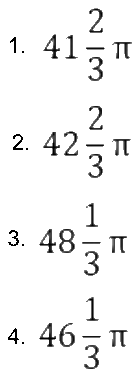
Q2.If the diameter of a hemisphere is 8 cm, then the volume of the hemisphere (in cm3) is:
- A.1
- B.2
- C.3
- D.4
Show answer
Answer: B. 2
Q3.How many digits will be there after the decimal point in the product of 0.325 and 1.0302?
- A.8
- B.5
- C.7
- D.6
Show answer
Answer: D. 6
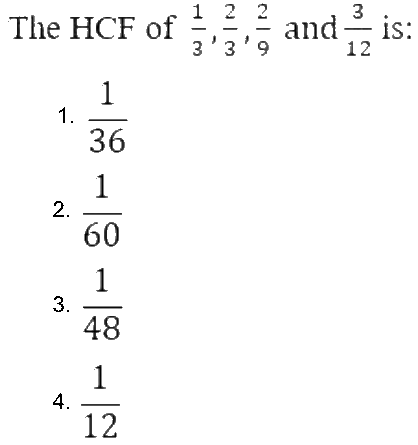
Q4.Select the correct option based on the image given below.
- A.1
- B.2
- C.3
- D.4
Show answer
Answer: A. 1
Q5.Select the correct option based on the image given below.

- A.₹5,200
- B.₹4,000
- C.₹5,000
- D.₹4,800
Show answer
Answer: A. ₹5,200
Q6.A sum of money was borrowed and paid back in two annual installments of ₹960 each, allowing 5% compound interest. The sum borrowed was:
- A.₹1,785.03
- B.₹1,850.05
- C.₹1,695.05
- D.₹1,875.03
Show answer
Answer: A. ₹1,785.03
Q7.After allowing a discount of 20% on the marked price of an article, it is sold for ₹500. Find its marked price.
- A.₹550
- B.₹520
- C.₹625
- D.₹525
Show answer
Answer: C. ₹625
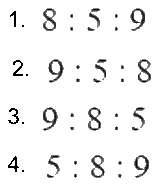
Q8.The ratio of incomes of A, B and C is 3 : 5 : 4. If the income of A is tripled, the income of C is doubled and the income of B remains the same, what is the ratio of their new incomes?
- A.1
- B.2
- C.3
- D.4
Show answer
Answer: B. 2
Q9.Farida shifted to a job in the social sector at a monthly salary that was 28% less than the monthly salary she was getting in her previous job. If Farida’s monthly salary in the job in the social sector is ₹27,000, what was her monthly salary (in ₹) in the previous job?
- A.36000
- B.37500
- C.38250
- D.38500
Show answer
Answer: B. 37500
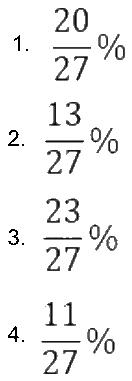
Q10.The difference between the simple interests on ₹1,800 for 3 years at different rates is ₹40. The difference between the rates of interest is:
- A.1
- B.2
- C.3
- D.4
Show answer
Answer: A. 1
Q11.The average age of students (boys and girls) of a class is 16.8 years. The average age of the boys in the class is 17.6 years and that of the girls is 16.4 years. The ratio of the number of boys to the number of girls in the class is:
- A.1 : 2
- B.2 : 3
- C.2 : 1
- D.3 : 2
Show answer
Answer: A. 1 : 2
Q12.The compound interest on a certain sum for 2 years at a certain rate of interest is ₹1,996.80 if the interest is compounded annually, and the simple interest on the same sum for the same time and at the same rate of interest is ₹1,920. The amount (in ₹) for the same sum, interest compounded annually, at the same rate of interest for 3 years is:
- A.14,761.35
- B.14,167.34
- C.15,116.54
- D.15,611.45
Show answer
Answer: C. 15,116.54
Q13.In the first year, the population of a village increases by 10%, and in the second year, it diminishes by 12%. At the end of the second year, its population was 14520. What was the population at the beginning of the first year?
- A.14750
- B.15000
- C.15250
- D.13500
Show answer
Answer: B. 15000
Q14.The value of (¼ of 1½) ÷ (3½ − 1¼) of 1½ − 1½ ÷ 2¼ + 1⅓ is:
- A.7/9
- B.11/9
- C.5/9
- D.17/9
Show answer
Answer: A. 7/9
Q15.A fruit seller had some apples. He sells 30% of the apples and still has 245 apples left with him. The number of apples he had with him initially was:
- A.250
- B.400
- C.300
- D.350
Show answer
Answer: D. 350
Q16.A solid metallic sphere of radius 8 cm is converted into a solid right circular cylinder of radius x cm. If the height of the cylinder is 3 times the radius of the sphere, then the value of x is:
- A.5⁴⁄₅
- B.6²⁄₃
- C.3¹⁄₅
- D.5¹⁄₃
Show answer
Answer: D. 5¹⁄₃
Q17.If a, b and c are positive numbers such that (a² + b²) : (b² + c²) : (c² + a²) = 34 : 61 : 45, then a : b : c = ?
- A.6 : 3 : 5
- B.5 : 3 : 6
- C.3 : 5 : 6
- D.3 : 6 : 5
Show answer
Answer: C. 3 : 5 : 6
Q18.In a test, the average score of 52 students is 45. If the highest and the lowest scores (got by only one-one student) are excluded, the average score of the remaining students would decrease by 1. What is the average score of the highest and the lowest scores?
- A.64
- B.65
- C.68
- D.70
Show answer
Answer: D. 70
Q19.A certain sum amounts to ₹9,900 in 4 years and to ₹11,700 in 7 years at the same rate per cent per annum at simple interest. What will be the amount of the same sum at 8²⁄₃% for 2¹⁄₄ years at simple interest?
- A.₹8,924
- B.₹8,952.75
- C.₹8,904
- D.₹8,962.50
Show answer
Answer: D. ₹8,962.50
Q20.If 80% of 50% of A is equal to three times 25% of B, then A is what percentage more or less than B?
- A.46.7% more
- B.87.5% less
- C.87.5% more
- D.46.7% less
Show answer
Answer: C. 87.5% more
Q21.A hall is 14 m long and 11 m broad. If the sum of the areas of the floor and the ceiling is equal to the sum of the areas of the four walls, then the volume (in m³) of the hall is:
- A.975.32
- B.948.64
- C.1000
- D.864.64
Show answer
Answer: B. 948.64
Q22.3 birds fly along the circumference of a jungle. They complete one round in 27 minutes, 45 minutes and 60 minutes, respectively. Since they start together, when will they meet again (in minutes) at the starting position?
- A.450
- B.540
- C.600
- D.360
Show answer
Answer: B. 540
Q23.The difference between a two-digit number and the number obtained by interchanging the digits is 54. What is the difference between the sum and the difference of the digits of the number if the ratio of the digits of the number is 1 : 3?
- A.4
- B.3
- C.6
- D.8
Show answer
Answer: C. 6
Q24.The distance between two places, A and B, is 190 km. A bus starts from A at 6 a.m. and travels towards B at 40 km/h. Another bus starts from B at 7 a.m. and travels towards A at 50 km/h. At what time will they meet?
- A.8.10 a.m.
- B.9.20 a.m.
- C.8.40 a.m.
- D.9 a.m.
Show answer
Answer: C. 8.40 a.m.
Q25.A is 30% more efficient than B and B can finish a certain job in 13 days. How many days will A alone take to complete the same job?
- A.7
- B.9
- C.10
- D.11
Show answer
Answer: C. 10
Q26.The total consumption of rice is 20 kg per month for a family. As the price of rice increases by 35%, the family reduces its consumption so that the expenditure of rice is increased only by 8%. What is the new consumption (in kg) of rice per month due to the increase in the price of rice?
- A.18
- B.14
- C.16
- D.12
Show answer
Answer: C. 16
Q27.Radha sold a watch at a profit of 12.5%. If she had sold it for ₹50 more, then the profit would have been 15%. The initial selling price (in ₹) of the watch is:
- A.2,250
- B.2,000
- C.1,125
- D.1,000
Show answer
Answer: A. 2,250
Q28.A, B and C agree to pay their total telephone bill in the proportion 3 : 5 : 7. A pays the first month's bill of ₹400, B pays the second month's bill of ₹560 and C pays the third day's bill of ₹840. How much amount (in ₹) should B pay to settle the accounts?
- A.20
- B.50
- C.30
- D.40
Show answer
Answer: D. 40
Q29.The ratio of the length and breadth of a rectangular park is 5 : 3, respectively. If a man walking along the boundary of the park at the speed of 6 km/h completes one round in 10 minutes, then the area of the park (in m²) is:
- A.59385.75
- B.58593.75
- C.58395.75
- D.53985.75
Show answer
Answer: B. 58593.75
Q30.Ram sold an article for ₹1,476, after allowing a 20% discount on its marked price. If he had not allowed any discount, he would have earned a profit of 24%. What is the cost price (in ₹) of the article (correct to two decimal places)?
- A.1,576.75
- B.1,187.76
- C.1,678.90
- D.1,487.90
Show answer
Answer: D. 1,487.90
Keep going
Frequently Asked Questions
How many Delhi Police Constable- SSC Numerical Ability (Quantitative Aptitude) previous year questions are available?
820 Numerical Ability (Quantitative Aptitude) questions from past Delhi Police Constable- SSC papers are available on AajExam, split into 82 practice sets. New questions are added as fresh papers are released.
Are the answers and explanations free?
Yes. Every question on this page shows its correct answer and explanation free of charge, and you do not need an account to read them. A free account only adds attempt tracking and performance analytics.
Do Delhi Police Constable- SSC repeat questions from previous years?
Exact repeats do occur, but the more reliable pattern is conceptual: the same Numerical Ability (Quantitative Aptitude) sub-topics reappear cycle after cycle with reworded questions. That is why working through past questions raises your score more reliably than reading theory alone.
How should I use these questions in my Delhi Police Constable- SSC preparation?
Attempt a set of ten cold, review every wrong and guessed question with its explanation, then drill the weak sub-topic on its topic page before moving on. Revisit the same set after a few days — your second-attempt accuracy is the honest measure of whether the concept stuck.
Delhi Police Constable- SSC Numerical Ability (Quantitative Aptitude) practice sets
Each set is a timed 10-question drill drawn from the same question bank.
- Delhi Police Constable- SSC - Numerical Ability (Quantitative Aptitude) PYQ Quiz 52
- Delhi Police Constable- SSC - Numerical Ability (Quantitative Aptitude) PYQ Quiz 62
- Delhi Police Constable- SSC - Numerical Ability (Quantitative Aptitude) PYQ Quiz 61
- Delhi Police Constable- SSC - Numerical Ability (Quantitative Aptitude) PYQ Quiz 60
- Delhi Police Constable- SSC - Numerical Ability (Quantitative Aptitude) PYQ Quiz 59
- Delhi Police Constable- SSC - Numerical Ability (Quantitative Aptitude) PYQ Quiz 58
- Delhi Police Constable- SSC - Numerical Ability (Quantitative Aptitude) PYQ Quiz 57
- Delhi Police Constable- SSC - Numerical Ability (Quantitative Aptitude) PYQ Quiz 56
- Delhi Police Constable- SSC - Numerical Ability (Quantitative Aptitude) PYQ Quiz 55
- Delhi Police Constable- SSC - Numerical Ability (Quantitative Aptitude) PYQ Quiz 54
- Delhi Police Constable- SSC - Numerical Ability (Quantitative Aptitude) PYQ Quiz 53
- Delhi Police Constable- SSC - Numerical Ability (Quantitative Aptitude) PYQ Quiz 63
- Delhi Police Constable- SSC - Numerical Ability (Quantitative Aptitude) PYQ Quiz 51
- Delhi Police Constable- SSC - Numerical Ability (Quantitative Aptitude) PYQ Quiz 50
- Delhi Police Constable- SSC - Numerical Ability (Quantitative Aptitude) PYQ Quiz 49
- Delhi Police Constable- SSC - Numerical Ability (Quantitative Aptitude) PYQ Quiz 48
- Delhi Police Constable- SSC - Numerical Ability (Quantitative Aptitude) PYQ Quiz 47
- Delhi Police Constable- SSC - Numerical Ability (Quantitative Aptitude) PYQ Quiz 46
- Delhi Police Constable- SSC - Numerical Ability (Quantitative Aptitude) PYQ Quiz 45
- Delhi Police Constable- SSC - Numerical Ability (Quantitative Aptitude) PYQ Quiz 44
- Delhi Police Constable- SSC - Numerical Ability (Quantitative Aptitude) PYQ Quiz 43
- Delhi Police Constable- SSC - Numerical Ability (Quantitative Aptitude) PYQ Quiz 73
- Delhi Police Constable- SSC - Numerical Ability (Quantitative Aptitude) PYQ Quiz 82
- Delhi Police Constable- SSC - Numerical Ability (Quantitative Aptitude) PYQ Quiz 81
- Delhi Police Constable- SSC - Numerical Ability (Quantitative Aptitude) PYQ Quiz 80
- Delhi Police Constable- SSC - Numerical Ability (Quantitative Aptitude) PYQ Quiz 79
- Delhi Police Constable- SSC - Numerical Ability (Quantitative Aptitude) PYQ Quiz 78
- Delhi Police Constable- SSC - Numerical Ability (Quantitative Aptitude) PYQ Quiz 77
- Delhi Police Constable- SSC - Numerical Ability (Quantitative Aptitude) PYQ Quiz 76
- Delhi Police Constable- SSC - Numerical Ability (Quantitative Aptitude) PYQ Quiz 75
- Delhi Police Constable- SSC - Numerical Ability (Quantitative Aptitude) PYQ Quiz 74
- Delhi Police Constable- SSC - Numerical Ability (Quantitative Aptitude) PYQ Quiz 42
- Delhi Police Constable- SSC - Numerical Ability (Quantitative Aptitude) PYQ Quiz 72
- Delhi Police Constable- SSC - Numerical Ability (Quantitative Aptitude) PYQ Quiz 71
- Delhi Police Constable- SSC - Numerical Ability (Quantitative Aptitude) PYQ Quiz 70
- Delhi Police Constable- SSC - Numerical Ability (Quantitative Aptitude) PYQ Quiz 69
- Delhi Police Constable- SSC - Numerical Ability (Quantitative Aptitude) PYQ Quiz 68
- Delhi Police Constable- SSC - Numerical Ability (Quantitative Aptitude) PYQ Quiz 67
- Delhi Police Constable- SSC - Numerical Ability (Quantitative Aptitude) PYQ Quiz 66
- Delhi Police Constable- SSC - Numerical Ability (Quantitative Aptitude) PYQ Quiz 65